
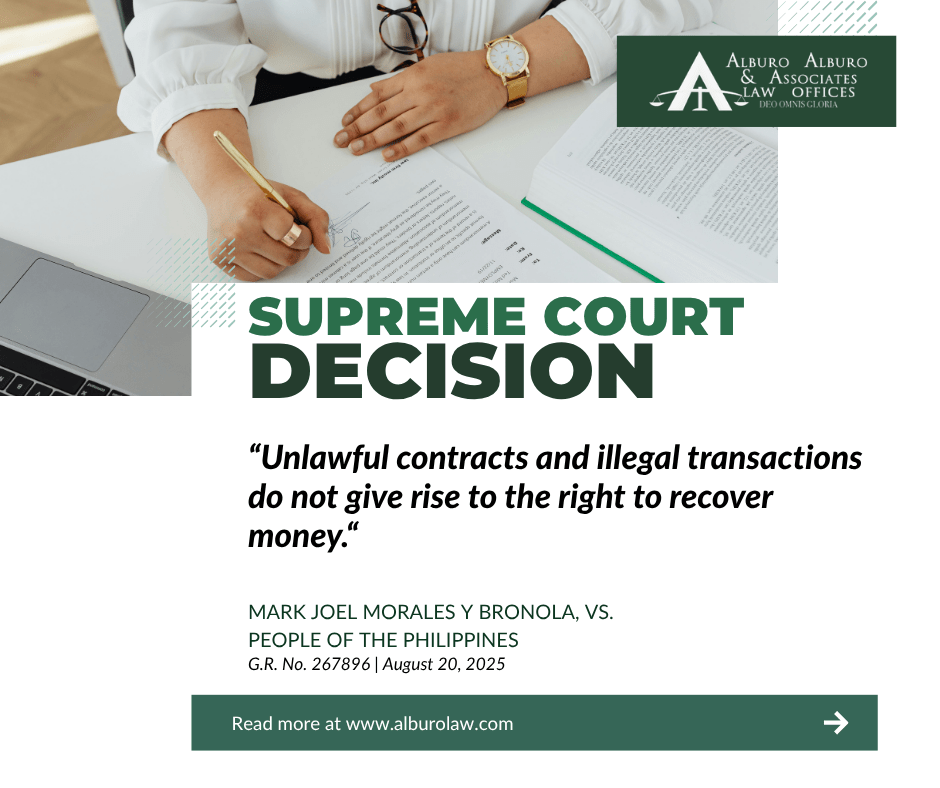
Photo from Pexels | www.kaboompics.com
This article is provided for general informational purposes only and does not create, nor shall it be construed as creating, a lawyer-client relationship between Alburo Alburo and Associates Law Offices (or any of its lawyers) and the reader. For advice on specific legal concerns, you are encouraged to engage the services of a qualified lawyer. You may also directly consult Alburo Alburo and Associates Law Offices for proper guidance tailored to your situation.
The views and information presented herein are based on the laws, rules, and jurisprudence prevailing at the time of writing. They do not take into account subsequent legal developments and should not be relied upon as a substitute for professional legal advice.
AT A GLANCE:
The Supreme Court held that the rule is that where the contract is illegal and constitutes a criminal offense, and both parties are in pari delicto or ‘in equal fault,’ the courts will leave them where they are found. This doctrine rests on the maxim ex dolo malo non oritur action, “no action arises from a wrongful cause,” and is designed to discourage illegal agreements by refusing judicial aid to either party.
This case stemmed from an Information charging Petitioner Morales with the crime of Estafa under Article 315(2)(a) of the Revised Penal Code for allegedly defrauding Catherine M. Factor-Koura by inducing her to pay PhP15,800,000.00 in exchange for a guaranteed party-list congressional seat and a money-back guarantee if unsuccessful.
Catherine was introduced to petitioner and co-accused Armando Almo Co through Edwin Aniñon. Armando represented that Catherine could secure a nomination under Ang Chinoy Party-list for PHP15 million. A Memorandum of Agreement (MOA) was executed, including a refund clause. Catherine paid a total of PHP17 million.
The COMELEC later on denied the accreditation of Ang Chinoy Party-list, hence they did not qualify for the election, thus they did not obtain the amount of PhP15,800,000.00.
Upon arraignment, the Petitioner and his co-accused entered their pleas of “Not Guilty.” Despite a Hold Departure Order, Armando absconded and the trial proceeded in absentia as to him. Petitioner denied any participation in a scheme to defraud Catherine, claiming he merely facilitated meetings and had no involvement in the financial transactions, which were conducted solely between Catherine and Armando.
In its Decision, the Regional Trial Court (RTC) ruled finding the Petitioner and Armando guilty of Estafa, while acquitting Edwin for failure of the Prosecution to prove his guilt beyond reasonable doubt.
On appeal to the Court of Appeals (CA), they affirmed the RTC’s decision in toto, sustaining the Petitioner’s conviction. Aggrieved, petitioner filed a motion for reconsideration, but the CA denied it in its Resolution.
Hence, Petitioner filed a Petition for Review on Certiorari, arguing that there was no conspiracy and no proof of any overt act showing a shared criminal intent to defraud Catherine.
One of the issues before the Court is whether Catherine may recover the money she paid under an illegal agreement for a party-list congressional seat.
The Supreme Court held that Catherine is barred from recovering the amount she paid under the doctrine of in pari delicto, considering that the transaction involved the payment of money in exchange for a Congressional seat through the party-list system.
In the case of Gonzalo v. Tarnate, Jr., G.R. No. 160600, January 15, 2014, the Court stressed that in cases of in pari delicto “no action arises, in equity or at law, from an illegal contract; no suit can be maintained for its specific performance, or to recover the property agreed to be sold or delivered, or the money agreed to be paid, or damages for its violation; and where the parties are in pari delicto, no affirmative relief of any kind will be given to one against the other.”
The rule is that where the contract is illegal and constitutes a criminal offense, and both parties are in pari delicto or ‘in equal fault,’ the courts will leave them where they are found. This doctrine rests on the maxim ex dolo malo non oritur action, “no action arises from a wrongful cause,” and is designed to discourage illegal agreements by refusing judicial aid to either party.
Undoubtedly, contracts that have for their object the trafficking of public office by unlawful means or the manipulation of electoral processes are void for being contrary to public policy. They are not only tainted with illegality from inception, but also subvert democratic processes and erode public trust in the electoral system.
All told, as both Catherine and Armando stand on equal footing in terms of culpability for the illegal transaction, the doctrine of in pari delicto bars Catherine from recovering the amount she paid to Armando.
Related article:
Click here to subscribe to our newsletter
Alburo Alburo and Associates Law Offices specializes in business law and labor law consulting. For inquiries regarding legal services, you may reach us at info@alburolaw.com, or dial us at (02)7745-4391/ 09175772207/ 09778050020.
All rights reserved.