
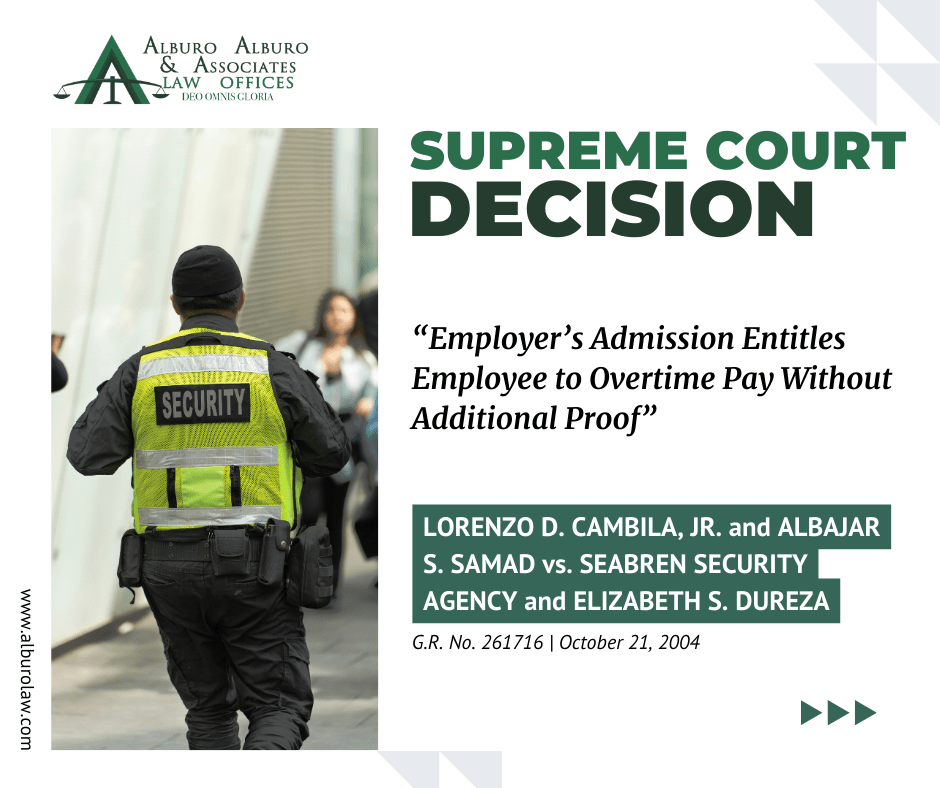
Photo from Unsplash | Krzysztof Hepner
The following post does not create a lawyer-client relationship between Alburo Alburo and Associates Law Offices (or any of its lawyers) and the reader. It is still best for you to engage the services of a lawyer or you may directly contact and consult Alburo Alburo and Associates Law Offices to address your specific legal concerns, if there is any.
Also, the matters contained in the following were written in accordance with the law, rules, and jurisprudence prevailing at the time of writing and posting, and do not include any future developments on the subject matter under discussion.
AT A GLANCE:
An employer’s formal admission that its employees worked beyond eight hours should entitle the employee to overtime compensation — without need of further proof.
Seabren hired Cambila and Samad as security guards, and assigned them at Ecoland, until they were allegedly terminated from work.
The security guards alleged that during their assignment at Ecoland, Seabren obliged them to render a 12-hour duty from 7:00 a.m. to 7:00 p.m. without any rest day for a daily wage of PHP300.37 (PHP300.06 for Cambila). According to the security guards, Seabren did not pay them overtime pay, holiday pay, rest day pay, and 13th month pay. On top of that, Seabren deducted an amount ranging from PHP200.00 to PHP400.00 from their salary supposedly for their 13th month pay.
Sometime in November 2017, the security guards complained to Seabren’s management and asked for an increase in their salary in accordance with the minimum wage set by the Regional Tripartite Wages and Productivity Board, but their requests were ignored. Instead, Seabren informed the security guards that they were relieved from their post at Ecoland, but they would be transferred to another post with the same pay.
Consequently, Cambila and Samad were constrained to resign. For their part, Seabren maintained that petitioners were not terminated. Instead, they resigned from work.
Seabren averred that based on the above Duty Detail Order (DDO), the security guards only rendered eight hours of work under a set-up of broken periods, and during their four-hour break, they may choose to go out of the establishment. Seabren however admitted that it has been the long-time practice of the security guards that during the break time, they do not already go out of the establishment to take their break. They just wait until the resumption of their respective duty time schedule.
Procedural History:
On November 29, 2018, the Labor Arbiter (LA) rendered a Decision declaring that the security guards were not illegally dismissed. In so ruling, the LA found that the four-hour work break under the security guard’s DDO was violative of the Implementing Rules of the Labor Code and considered it as a compensable working time.
Aggrieved, Seabren and Ecoland filed separate appeals before the National Labor Relations Commission (NLRC) which affirmed the ruling of the LA with modification in that Ecoland should only be held solidarily liable with Seabren to the extent of the work performed under their service contract.
NLRC found that there was really no need for the broken period arrangement because Seabren itself admitted that the security guards did not leave their post during the alleged break period.
Seabren belatedly filed a Motion for Reconsideration which the NLRC resolved to deny for lack of merit.
Undaunted, Seabren and Dureza filed a Petition for Certiorari before the CA partially granted the petition and deleted the award of overtime pay.
Aggrieved, petitioners filed a Motion for Partial Reconsideration. In turn, Seabren filed a Manifestation stating that on August 12, 2021, the other security guards filed their respective waiver, release, and quitclaim in favor of Seabren and settled their dispute. In the assailed Resolution, the CA noted Seabren’s Manifestation and denied the motion for reconsideration filed by petitioners.
Hence, petitioners elevated the case before the Court.
The issue is whether the CA erred in deleting the award of overtime pay in favor of petitioners.
THE SUPREME COURT DECIDES
The Supreme Court ruled in favor of the Petitioners stating that the CA erred in deleting the award of overtime pay in favor of the Petitioners.
In determining the employee’s entitlement to monetary claims, jurisprudence dictates that the burden of proof shifts from the employer or the employee, depending on the monetary claim sought. For claims for payment of 13th-month pay, salary differentials, and holiday pay, among others, the burden of proof falls upon the employer considering that the records pertinent to such claims are usually in the employer’s control and custody. While in claims for overtime pay and premium pay for holidays and rest days, the burden of proof falls upon the employee since these monetary claims are not incurred in the normal course of business. Thus, to be entitled to overtime pay, it is incumbent upon petitioners to first prove that they rendered service above the regular eight working hours a day.
In claiming that they rendered overtime work but were not paid for it, petitioners presented the DTRs to show that they performed work in excess of the regular eight hours a day. On the one hand, the LA and the NLRC gave credence to the DTRs and found that petitioners were entitled to overtime pay. On the other hand, the CA considered the DTRs as self-serving evidence solely because they did not bear the signature of their timekeeper or any of Seabren’s representatives.
Instead, the DTRs contained the countersignature of Ecoland’s manager Adtoon, who certified that petitioners rendered 12 hours of continuous work per day. While Adtoon is not a representative of Seabren, it is undisputed that Ecoland is Seabren’s client and petitioners were assigned by Seabren to guard the premises of Ecoland. It was Ecoland, through its manager, Adtoon, who was logically in the best position to monitor, authenticate, and/or countersign the petitioners’ DTRs. Thus, the LA and NLRC correctly considered the DTRs which showed that petitioners worked continuously from “07:00 to 19:00” without any interruption.
Moreover, the entries made in the DTRs constitute prima facie evidence that petitioners rendered overtime work. Prima facie evidence is such evidence as, in the judgment of the law, is sufficient to establish a given fact, or the group, or chain of facts constituting the party’s claim or defense, and which if not rebutted or contradicted, will remain sufficient.
It bears stressing that respondents did not rebut the DDO which Magsayo, the operations manager, and Dureza signed showing “7am-7pm” or “7pm-7am” as the time shift of petitioners. Furthermore, Seabren, in its Position Paper, even admitted that the security guards do not leave the premises of Ecoland during the alleged four-hour work break.
The Omnibus Rules Implementing the Labor Code is clear that the time during which an employee is inactive by reason of interruptions in his work beyond his control shall be considered working time . . . if the interval is too brief to be utilized effectively and gainfully in the employee’s own interest. It was simply impractical, inconvenient, and uneconomical for the security guards, who are minimum wage earners, to report to work, go home and/or leave Ecoland’s premises, only to report back within the same day. Thus, the Court agrees with the NLRC that the broken period scheme employed by Seabren was made to circumvent our labor laws and avoid paying petitioners their overtime pay.
In Lepanto Consolidated Mining Co. v. Mamaril, citing Damasco v. NLRC, an employer’s formal admission that its employees worked beyond eight hours should entitle the employee to overtime compensation — without need of further proof.
Hence, the CA gravely erred in deleting the award of overtime pay to petitioners on the pretext that the claim has no factual basis.
Time and again, the rule is that any doubt arising from the evaluation of evidence as between the employer and the employee must be resolved in favor of the latter. Had Seabren truly intended that petitioners should work only eight hours a day, then it would not have resorted to such an iniquitous scheme.
Click here to subscribe to our newsletter
Alburo Alburo and Associates Law Offices specializes in business law and labor law consulting. For inquiries regarding legal services, you may reach us at info@alburolaw.com, or dial us at (02)7745-4391/ 09175772207/ 09778050020.
All rights reserved.
Leave a Reply