

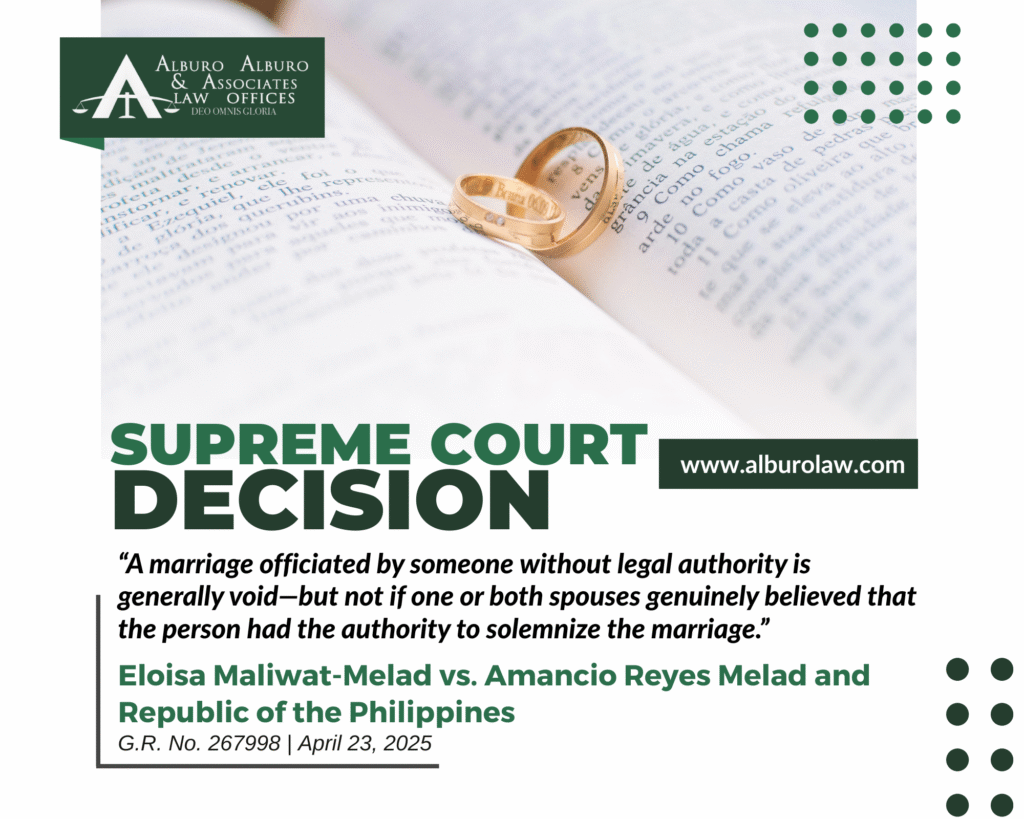
Photo from Pexels | Caio
The following post does not create a lawyer-client relationship between Alburo Alburo and Associates Law Offices (or any of its lawyers) and the reader. It is still best for you to engage the services of a lawyer or you may directly contact and consult Alburo Alburo and Associates Law Offices to address your specific legal concerns, if there is any.
Also, the matters contained in the following were written in accordance with the law, rules, and jurisprudence prevailing at the time of writing and posting, and do not include any future developments on the subject matter under discussion.
AT A GLANCE:
Article 35 (2) of the Family Code provides that marriages officiated by person with no legal authority are considered void, except if one or both parties to the marriage believed in good faith that the officer had legal authority to solemnize the marriage.
On March 23, 1990, petitioner Eloisa Maliwat-Melad and private respondent Amancio Reyes Melad got married at the Municipal Hall of Tarlac City, Tarlac. Their marriage contract showed that the marriage was solemnized by Judge Conrado De Gracia.
Throughout their marriage, Eloisa and Amancio encountered various marital problems. In 2017, Eloisa consulted her lawyer, Atty. Eduardo Cunanan regarding the possibility of filing a legal separation case against Amancio.
Eloisa explained to Atty. Cunanan that although she arranged the wedding, neither she nor anyone else knew Judge De Gracia. She thought that the person who solemnized their marriage was the judge himself.
Consequently, Eloisa filed a petition with the Regional Trial Court (RTC) to declare her marriage to Amancio as void on the ground of lack of authority of the solemnizing officer. Summons were served upon Amancio, but he failed to file a responsive pleading and appear before the court. Deputy City Prosecutor Liza C. Olinares-Agliam certified that no collusion existed between Eloisa and Amancio.
Eloisa submitted the three (3) pictures of her marriage ceremony as evidence. She claimed that the person wearing a white polo shirt with stripes, and who officiated her marriage, was a certain Rosalio Florendo and not Judge De Gracia.
Roland Atiburcio Quilana testified that he was one of the guests present during the marriage ceremony of Eloisa and Amancio. He also admitted that he did not know what Judge De Gracia looked like, and he thought all along that the person in the picture who appeared to officiate the marriage was the judge.
Atty. Cunanan testified that he personally knew Judge De Gracia as a municipal court judge in the 1990s because he used to visit him in his chambers. He and Judge De Gracia were part of a religious-oriented group called “Marriage Encounter 3” in Tarlac City. When Eloisa showed him a picture of her marriage ceremony, he identified the solemnizing officer as Rosalio Florendo, whom he also personally knew as a co-member of the Rotary Club in Tarlac City.
The RTC denied Eloisa’s petition. The RTC ruled that the testimonies of Eloisa, Quilana, and Atty. Cunanan did not sufficiently establish the identities of Judge De Gracia and Florendo, and who among the two (2) actually officiated the marriage of Eloisa and Amancio.
The Court of Appeals (CA) affirmed the RTC in toto. The CA ruled that the marriage contract, being a public document, serves as a prima facie proof of marriage and evidence of the facts stated in the document. However, Eloisa failed to present clear and convincing evidence to rebut the prima facie presumption. Hence, this petition.
The issue in this case is whether the marriage of petitioner and private respondent was void ab initio on the ground of lack of authority of the solemnizing officer.
The Supreme Court Decides
The Supreme Court dismissed the petition and affirmed the CA’s decision and resolution. It ruled that petitioner failed to prove, by clear and convincing evidence, that her marriage to private respondent was void ab initio on the ground of lack of authority of the solemnizing officer.
The marriage certificate shows that petitioner and private respondent’s marriage took place in Tarlac City and was solemnized by Judge De Gracia, a judge of Tarlac City. The solemnizing officer, being then an incumbent judge within the jurisdiction of Tarlac City, had the legal authority to officiate the marriage pursuant to Article 7 (1) of the Family Code.
The marriage contract, being a public document, is not only a prima facie proof of marriage, but is also a prima facie evidence of the facts stated therein. Thus, since petitioner failed to prove, by clear and convincing evidence, the lack of authority of the solemnizing officer, the marriage is valid. The legal presumption accorded to public documents, in favor of the authority of the solemnizing officer, and towards the validity of marriage, must be upheld.
Article 35 (2) of the Family Code provides that marriages officiated by a person with no legal
authority are considered void, except if one or both parties to the marriage believed in good faith that the officer had legal authority to solemnize the marriage. Thus, petitioner’s case falls under the exception of void marriages as provided in Article 35 (2) of the Family Code. Petitioner’s marriage with private respondent is valid owing to her genuine belief, in good faith, that the solemnizing officer had the legal authority to officiate her marriage with private respondent.
Click here to subscribe to our newsletter
Alburo Alburo and Associates Law Offices specializes in business law and labor law consulting. For inquiries regarding legal services, you may reach us at info@alburolaw.com, or dial us at (02)7745-4391/ 09175772207/ 09778050020.
All rights reserved.
Leave a Reply