Home
About Us
Core Values, Mission & Vision
Partners
Atty. Alvin Liao Alburo, LL.M.
Atty. Rizzle May Ostia-Alburo
Affiliations & Awards
Practice Areas
Legal Services
Virtual Library
Downloadable Forms
DOLE Handbook
DOLE Library
Department Orders
2026
2025
2024
2023
Labor Advisories
2026
2025
2024
2023
Articles & Videos
Featured Videos
Business Law
Labor Law
Others
Supreme Court Decisions
Legal Articles
Legal FAQs
Topics Directory
Bulletin Board
Training Calendar
Events
Media
Careers
Career Opportunities
Internship Program
Intern Insights
Contact Us
Home
About Us
Core Values, Mission & Vision
Partners
Atty. Alvin Liao Alburo, LL.M.
Atty. Rizzle May Ostia-Alburo
Affiliations & Awards
Practice Areas
Legal Services
Virtual Library
Downloadable Forms
DOLE Handbook
DOLE Library
Department Orders
2026
2025
2024
2023
Labor Advisories
2026
2025
2024
2023
Articles & Videos
Business Law
Labor Law
Others
Supreme Court Decisions
Legal Articles
Legal FAQs
Topics Directory
Bulletin Board
Training Calendar
Events
Media
Careers
Career Opportunities
Internship Program
Intern Insights
Contact Us
Tag:
Supreme Court
January 11, 2026
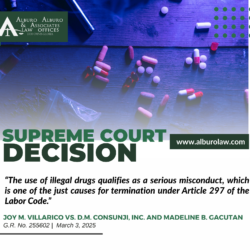
The Supreme Court Decides: The use of illegal drugs qualifies as a serious misconduct, which is one of the just causes for termination under Article 297 of the Labor Code.
January 4, 2026
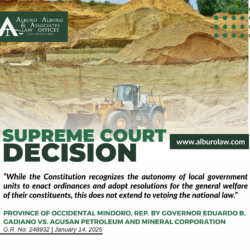
The Supreme Court Decides: While the Constitution recognizes the autonomy of local government units to enact ordinances and adopt resolutions for the general welfare of their constituents, this does not extend to vetoing the national law.
December 28, 2025
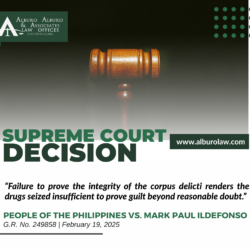
The Supreme Court Decides: Failure to prove the integrity of the corpus delicti renders the drugs seized insufficient to prove guilt beyond reasonable doubt.
December 21, 2025
The Supreme Court Decides: A strict and rigid application of the rules which would result in technicalities that tend to frustrate rather than promote substantial justice must be avoided.
December 14, 2025
The Supreme Court Decides: Public officers may be held liable for malversation even if they do not use public property or funds under their custody for their personal benefit.
December 7, 2025
The Supreme Court Decides: The workers were entitled to the same rights and benefits as regular employees of the employer.
November 30, 2025
The Supreme Court Decides: Petitioner is not entitled to permanent and total disability benefits but only to Grade 12 disability benefits as found by the company-designated doctors
November 23, 2025
The Supreme Court Decides: As a general rule, only the employer-corporation, and not its officers, may be held liable for illegal dismissal of employees. The exception applies when corporate officers acted with bad faith.
November 16, 2025
The Supreme Court Decides: Reinstatement presupposes that the previous position from which the employee has been removed is still in existence or there is an unfilled position of a nature, more or less, similar to the one previously occupied by said employee.
Previous Page
1
2
3
4
…
11
Next Page
Search for an article
Search
Search