

AT A GLANCE:
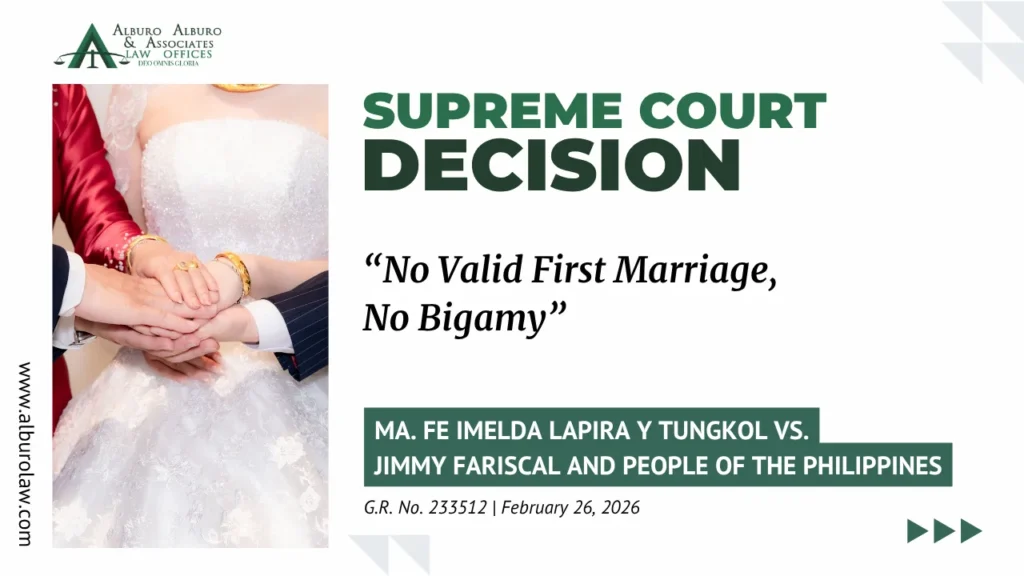
In a prosecution for Bigamy, the Supreme Court acquitted Ma. Fe Imelda Lapira after finding that the prosecution failed to establish the existence of a prior valid marriage, which is an essential element of the crime. Applying its ruling in Pulido v. People, the Court held that a judicial declaration of absolute nullity is not necessary before an accused in a bigamy case may invoke the void ab initio status of a prior marriage as a defense.
An Information was filed against Ma. Fe Imelda Lapira y Tungol (Imelda) for Bigamy under Article 349 of the Revised Penal Code. The prosecution alleged that while her marriage to Japanese national Takahiko Sato, celebrated on August 3, 2000, was still valid and subsisting, she contracted a second marriage with Jimmy Fariscal on April 17, 2001.
Jimmy testified that, upon verification with the Office of the Civil Registrar General, Imelda was previously married to a Japanese national named Takahiko Sato. The Certificate of Marriage Jimmy obtained from the Office of the Civil Registrar General shows that Imelda had contracted marriage with Takahiko Sato on August 3, 2000 in Meycauayan, Bulacan.
Imelda insisted that she did not commit bigamy. She asserted that her marriage with Takahiko Sato was a sham as it was merely resorted to in order for her to legally and expeditiously enter Japan. She claimed that no marriage had taken place between her and Takahiko Sato since what she signed was not a marriage contract but a blank piece of bond paper. When she affixed her signature on a piece of blank bond paper in Makati City, neither Takahiko Sato nor the solemnizing officer were present.
As proof, Imelda submitted the Certification dated January 14, 2009 issued by the Office of the Civil Registrar of Imus, Cavite, which states that “no record of application for marriage license of Takahiko Sato and Ma. Fe Imelda Lapira” and that the records for the year 2000 were still intact in the archives.
The Regional Trial Court found Imelda guilty of Bigamy, and the Court of Appeals affirmed her conviction, holding that she could not invoke the alleged voidness of her first marriage because it had not been judicially declared void before she contracted the second marriage.
Imelda then elevated the case to the Supreme Court.
The issue lies whether Imelda is guilty of the crime of Bigamy.
The Supreme Court granted the petition and acquitted Imelda.
Applying its En Banc ruling in Pulido v. People, the Court held that a judicial declaration of absolute nullity is not necessary to prove a void ab initio marriage in a prosecution for Bigamy. Thus, an accused may raise the voidness of the first marriage as a defense even without first obtaining a judicial declaration of nullity.
Under Article 349 of the Revised Penal Code, the elements of Bigamy are:
- the offender has been legally married;
- the first marriage has not been legally dissolved, or in case his or her spouse is absent, the absent spouse has not been judicially declared presumptively dead;
- he contracts a subsequent marriage; and
- the subsequent marriage would have been valid had it not been for the existence of the first.
Stated otherwise, one of the essential elements of Bigamy is a prior valid marriage. If the supposed first marriage was void ab initio, it is inexistent from the beginning, and an element of the felony would be lacking.
Applying the foregoing, Imelda assailed the validity of her prior marriage to Takahiko on the absence of a valid marriage license. As proof, she submitted the January 14, 2009 Certification issued by the Office of the Civil Registrar of Imus, Cavite.
According to Article 3 of the Family Code, a valid marriage license is a formal requisite of marriage. In connection with this, Article 4 of the Family Code provides that the absence of any of the essential or formal requisites shall render the marriage void ab initio, except as stated in Article 35(2).
The Court found that Imelda sufficiently proved the absence of a marriage license through the Certification issued by the Local Civil Registrar of Imus, Cavite, which stated that there was no record of any application for a marriage license by Imelda and Takahiko. Citing Cariaga v. Republic, the Court held that for a marriage to be considered void due to the lack of a marriage license, the absence of such license must be apparent on the marriage contract, or at the very least, supported by a certification from the local civil registrar that no such marriage license was issued to the parties. Imelda’s claim that her first marriage was void due to the absence of a marriage license was supported by the January 14, 2009 Certification. Thus, there was compliance with the evidentiary requirements laid down in Cariaga.
The Court likewise ruled that although a marriage certificate, as a public document, is prima facie evidence of its contents, this presumption is rebuttable. Imelda’s evidence sufficiently rebutted the presumed regularity of the alleged marriage certificate between her and Takahiko. The prosecution relied primarily on the marriage certificate to prove the first element of Bigamy, that the offender had been legally married. However, the presumption of such marriage certificate was overturned, particularly by the defense’s submission of the January 14, 2009 Certification.
There being no other proof of the validity of the marriage between Takahiko and Imelda, then there is reasonable doubt as to the existence of a prior marriage, which is one of the elements of Bigamy.
The Court further reiterated, as it did in Pulido, the time-honored principle that penal statutes are construed strictly against the State and liberally in favor of the accused. To require a judicial declaration of absolute nullity before an accused in a criminal prosecution for Bigamy may invoke a void ab initio marriage as a defense would interpret Article 349 too liberally in favor of the State and too strictly against the accused.
Accordingly, the Court held that the prosecution failed to establish all the elements of Bigamy. Applying the rule that penal statutes are construed strictly against the State and liberally in favor of the accused, it acquitted Imelda on the ground of reasonable doubt.
Related article/s:
Click here to subscribe to our newsletter
Alburo Alburo and Associates Law Offices specializes in business law and labor law consulting. For inquiries regarding legal services, you may reach us at info@alburolaw.com, or dial us at (02)7745-4391/ 09175772207/ 09778050020.
All rights reserved.