

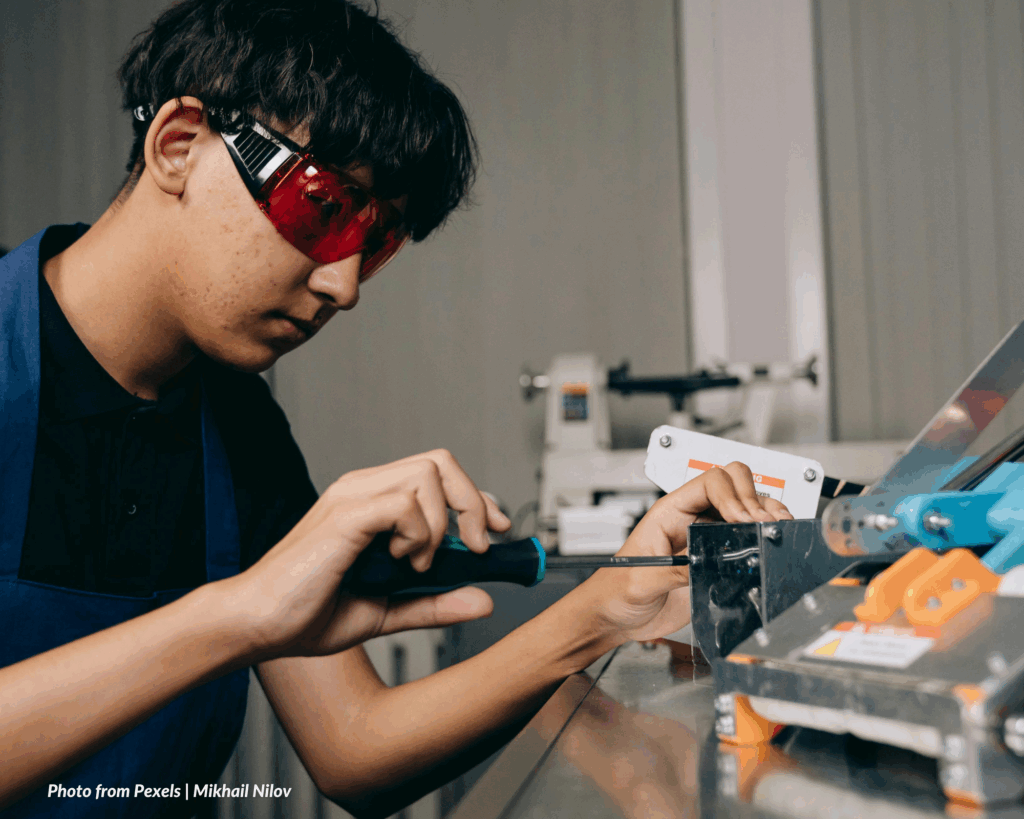
Photo from Pexels | Mikhail Nilov
The following post does not create a lawyer-client relationship between Alburo Alburo and Associates Law Offices (or any of its lawyers) and the reader. It is still best for you to engage the services of a lawyer or you may directly contact and consult Alburo Alburo and Associates Law Offices to address your specific legal concerns, if there is any.
Also, the matters contained in the following were written in accordance with the law, rules, and jurisprudence prevailing at the time of writing and posting, and do not include any future developments on the subject matter under discussion.
AT A GLANCE:
The Tulong-Trabaho Act or Republic Act (RA) No. 11230 was enacted in line with the policy of the State to promote a just and dynamic social order that will ensure the prosperity and independence of the nation, and free the people from poverty through policies that provide adequate social services, promote full employment, a rising standard of living, and an improved quality of life for all. For this purpose, the Constitution encourages nonformal, informal and indigenous learning systems, as well as self-learning, independent, and out-of-school study programs, particularly those that respond to community needs.
What are the objectives of RA No. 11230?
Section 3. Objectives. – This Act has the following objectives:
(a) To strengthen the qualifications of the Filipino workforce to meet the challenges of the rapidly evolving workplaces and work structures;
(b) To provide for more innovative approaches to Technical Vocational Education and Training (TVET) linked to the requirement of industry to primarily address unemployment and job-skill mismatch;
(c) To facilitate access to quality TVET; and
(d) To encourage the participation of industry and communities in competencies formation and upgrading towards a more competitive Filipino workforce.
What does STP mean?
Selected Training Programs (STPs) approved by the TESDA Board based on the recommendations of pertinent industries refer to school-based, center-based, community-based, enterprise-based and web-based technical-vocational education and training programs;
What does TVET mean?
Technical-Vocational Education and Training (TVET) refers to the education or training process involving general education, the study of technologies and related sciences, acquisition of practical skills relating to occupations in various sectors of economic and social life, and comprises formal (organized programs as part of the school system) and nonformal (organized classes outside the school system) approaches.
How shall the STPs and TVETs be funded?
There shall be established a Tulong-Trabaho Fund that shall provide qualified recipients with access to TVET programs under the STPs to be determined by the TESDA Board through the full payment of the STPs’ training fees, as well as the additional financial assistance such as transportation allowance and laboratory fees, as needed.
All costs to be incurred in undergoing assessment and certification, issuance of national certificates and other documents, administrative and all other procedures required for the completion of the TVET programs under the STPs shall be free of charge to the qualified recipients under Section 9 of this Act.
The funds necessary for the implementation of this Act shall be immediately sourced from the TESDA budget in the current General Appropriations Act (GAA) and hereinafter be included in the GAA of the succeeding year.
The Tulong-Trabaho Fund shall be used to pay the fees of qualified recipients in STPs selected in accordance with Section 9 of this Act.
Who shall be considered as qualified recipients of the Tulong Trabaho Fund?
Access to the Tulong-Trabaho Fund shall be made available to:
(a) any person at least fifteen (15) years of age who are not employed, not in education and not in training (NEET), and
(b) employed workers who intend to develop and expand their current skills and trainings: Provided, That existing workers in enterprise-based companies or industries currently trained by their employers shall be excluded from the coverage of this Act.
How shall STPs be determined?
The TESDA Board shall approve the final list of STPs eligible to receive funding from the Tulong-Trabaho Fund based on the initial recommendation of the TESDA Secretariat.
STPs may be school-based, center-based, community-based, enterprise-based or web-based programs. The STPs shall initially be determined based on the following considerations:
(a) The latest issuances of Labor Market Intelligence Reports;
(b) Quantitative and qualitative data on employment opportunities to be provided by the DOLE;
(c) Quantitative and qualitative data on jobs and skills matching, as determined by the TESDA;
(d) The Human Resource Development Roadmaps; and
(e) Other quantitative and qualitative studies to be determined necessary by the TEDSA Board in its selection of STPs.1âwphi1
Provided, That the TESDA Board may, in its discretion, adopt additional bases to achieve the objectives of this Act.
The TESDA Board shall release the initial list of available STPs within two (2) months from the effectivity of this Act, and shall update such list in accordance with the provisions of this Act.
How shall qualified recipients be determined?
The industry boards or bodies seeking funding for STPs shall submit a list of trainees who have requested assistance from the Tulong-Trabaho Fund to the TESDA Regional Directors. The TESDA Regional Directors shall assess the recipients and submit a list of qualified recipients to the TESDA Director General for his/her approval.
The list of qualified recipients shall be periodically updated depending on the availability of the Tulong-Trabaho Fund and the number of STPs.
Click here to subscribe to our newsletter
Alburo Alburo and Associates Law Offices specializes in business law and labor law consulting. For inquiries regarding legal services, you may reach us at info@alburolaw.com, or dial us at (02)7745-4391/ 0917-5772207/ 09778050020.
All rights reserved.
Leave a Reply