Home
About Us
Core Values, Mission & Vision
Partners
Atty. Alvin Liao Alburo, LL.M.
Atty. Rizzle May Ostia-Alburo
Affiliations & Awards
Practice Areas
Legal Services
Virtual Library
Downloadable Forms
DOLE Handbook
DOLE Library
Department Orders
2026
2025
2024
2023
Labor Advisories
2026
2025
2024
2023
Articles & Videos
Featured Videos
Business Law
Labor Law
Others
Supreme Court Decisions
Legal Articles
Legal FAQs
Topics Directory
Bulletin Board
Training Calendar
Events
Media
Careers
Career Opportunities
Internship Program
Intern Insights
Contact Us
Home
About Us
Core Values, Mission & Vision
Partners
Atty. Alvin Liao Alburo, LL.M.
Atty. Rizzle May Ostia-Alburo
Affiliations & Awards
Practice Areas
Legal Services
Virtual Library
Downloadable Forms
DOLE Handbook
DOLE Library
Department Orders
2026
2025
2024
2023
Labor Advisories
2026
2025
2024
2023
Articles & Videos
Business Law
Labor Law
Others
Supreme Court Decisions
Legal Articles
Legal FAQs
Topics Directory
Bulletin Board
Training Calendar
Events
Media
Careers
Career Opportunities
Internship Program
Intern Insights
Contact Us
Author:
rizzlemay
January 19, 2026
WHO ARE CONSIDERED HEIRS UNDER THE LAW (PART II)
January 19, 2026
HOW IS NIGHT SHIFT DIFFERENTIAL PAY COMPUTED?
January 18, 2026
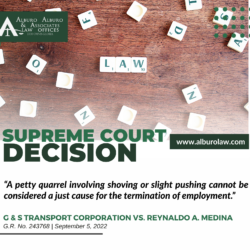
The Supreme Court Decides: A petty quarrel involving shoving or slight pushing cannot be considered a just cause for the termination of employment.
January 17, 2026
Child Pornography: Insights from People of the Philippines v. YYY (G.R. No. 262941)
January 16, 2026
COMPLETE SEPARATION OF PROPERTY DURING MARRIAGE
January 16, 2026
WHO ARE CONSIDERED HEIRS UNDER THE LAW? (Part I)
January 15, 2026
Determining the existence of Anti-Competitive Agreement or Conduct under the Philippine Competition Act
January 14, 2026
REJECTION AND REVOCATION OF REGISTRATION OF SECURITIES
January 14, 2026
MAY AN EXECUTED WILL BE SUPPLEMENTED?
Previous Page
1
…
9
10
11
12
13
…
154
Next Page
Search for an article
Search
Search