

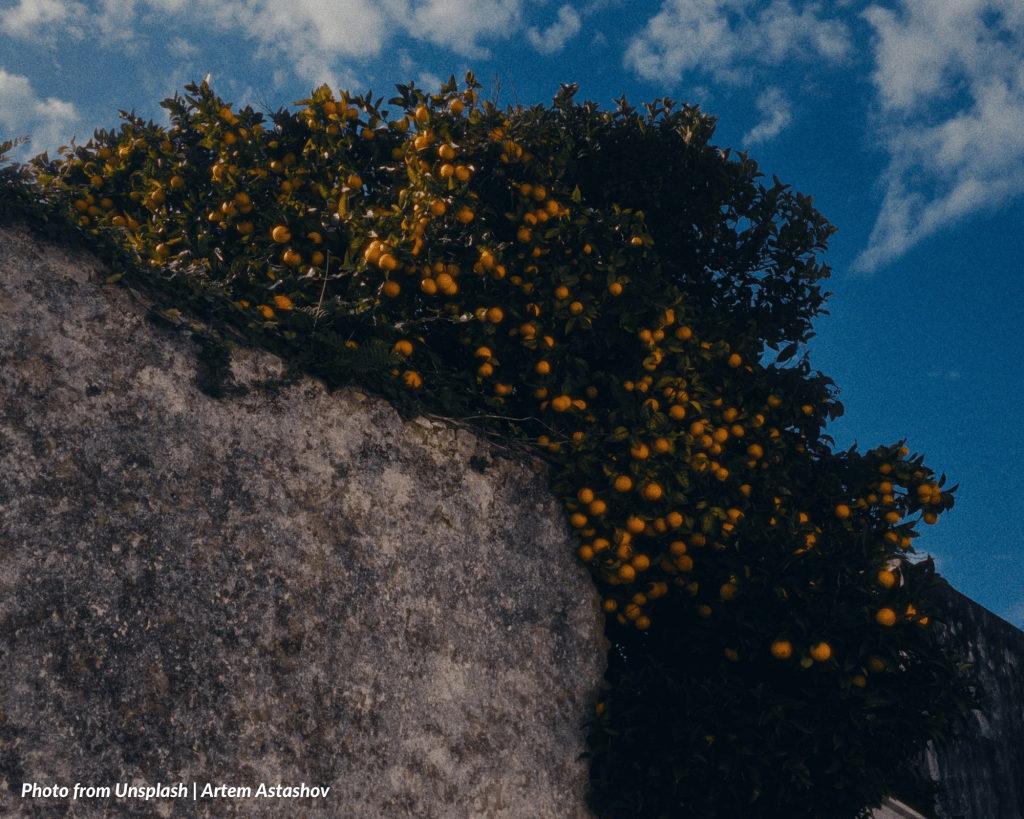
Photo from Unsplash | Artem Astashov
This article was originally published on June 1, 2022 and has been updated to reflect recent legal developments.
The following post does not create a lawyer-client relationship between Alburo Alburo and Associates Law Offices (or any of its lawyers) and the reader. It is still best for you to engage the services of a lawyer or you may directly contact and consult Alburo Alburo and Associates Law Offices to address your specific legal concerns, if there is any.
Also, the matters contained in the following were written in accordance with the law, rules, and jurisprudence prevailing at the time of writing and posting, and do not include any future developments on the subject matter under discussion.
AT A GLANCE:
Fruits that naturally fall onto adjacent land belong to the owner of that land under Article 681 of the Civil Code.
It is not uncommon for fruits from a neighbor’s tree to fall into another’s property. This raises a practical legal question: who owns these fruits?
Under Article 681 of the Civil Code of the Philippines, fruits naturally falling upon adjacent land belong to the owner of said land.
Thus, If the fruits from a neighboring tree fall naturally onto your property, you are legally entitled to them as the owner of the land where they fell.
However, this rule applies only when the fruits fall naturally. If the frits are still attached to the tree, ownership remains with the tree owner. Likewise, fruits that are taken down through artificial means, such as by shaking the tree or using poles, do not fall under this rule and remain the property of the tree owner.
The Civil Code also provides guidance when tree branches extend into a neighboring property. Article 680 of the Civil Code provides that:
“If the branches of any tree should extend over a neighboring estate, tenement, garden or yard, the owner of the latter shall have the right to demand that they be cut off insofar as they may spread over his property, and, if it be the roots of a neighboring tree which should penetrate into the land of another, the latter may cut them off himself within his property.”
Accordingly, the affected landowner does not have the right to unilaterally cut the protruding branches. Instead, the proper remedy is to demand that the owner of the tree cut them off. If such demand is ignored, the landowner must seek authority from the court before taking action.
In sum, while the law allows a landowner to keep fruits that naturally fall onto their property, it also maintains respect for ownership rights by prohibiting self-help remedies in dealing with overhanging branches.
Related Articles:
- WHAT IS EASEMENT?
- How Are Easements Acquired?
- CAUSES FOR EXTINGUISHMENT OF THE EASEMENT OF RIGHT OF WAY
Click here to subscribe to our newsletter
Alburo Alburo and Associates Law Offices specializes in business law and labor law consulting. For inquiries regarding legal services, you may reach us at info@alburolaw.com, or dial us at (02)7745-4391/ 09175772207/ 09778050020.
All rights reserved.