

AT A GLANCE:
It has been established by the Supreme Court that there can be no presumption of constructive dismissal due to allegations of having a nasty work environment. In the case where a person alleges to have suffered constructive dismissal, there must be convincing evidence to prove that the conduct of the employer made it impossible for such employment to continue.
Petitioner Herlyn Sabay Ferrer began working for Genpact on September 28, 2016 as a Process Associate. Ferrer claimed that she was subjected to bullying, insults, and humiliation by her coworkers. She claimed that the working environment at Genpact was undesirable, stating that her coworkers bullied, insulted, and humiliated her. She further asserted that Genpact assigned her additional tasks outside her regular workload and that her daily reports and office files were hacked, edited, and deleted. Despite reporting these incidents, Ferrer asserted that no action was taken by Genpact.
On September 5, 2017, Ferrer submitted a letter informing Genpact of her decision to resign. Genpact accepted her resignation through a letter dated October 3, 2017.
More than a year later, Ferrer filed a complaint for constructive dismissal and various monetary claims, arguing that the circumstances in her workplace rendered her continued employment impossible, unreasonable, and unlikely.
Genpact and Tyagarajan maintained that Ferrer was not dismissed but voluntarily resigned from her employment, and that she failed to present evidence showing that she was subjected to any pressure, condition, or circumstance that compelled her to resign. They further claimed that Ferrer had received her final pay and executed a quitclaim.
The Labor Arbiter dismissed the complaint. The NLRC affirmed, and the Court of Appeals sustained the ruling. Ferrer thereafter elevated the case to the Supreme Court.
The issue in this case lies whether Ferrer was constructively dismissed from employment.
The Court rules in the negative. Ferrer failed to adduce any evidence of constructive dismissal, and the records instead show that she voluntarily resigned from employment.
Constructive dismissal arises “when continued employment is rendered impossible, unreasonable or unlikely; when there is a demotion in rank and/or a diminution in pay; or when a clear discrimination, insensibility or disdain by an employer becomes unbearable to the employee.” Furthermore, the test of constructive dismissal is whether a reasonable person in the employee’s position would have felt compelled to give up his position under the circumstances.
It involves an act that amounts to dismissal but is made to appear otherwise. However, “bare allegations of constructive dismissal, unsupported by evidence on record, cannot be given credence.” In contrast, resignation contemplates a voluntary severance of employment. Resignation is the formal pronouncement or relinquishment of a position or office. It is the voluntary act of an employee, who is in a situation where he or she believes that personal reasons cannot be sacrificed in favor of the exigency of the service, and he or she has then no other choice but to disassociate himself or herself from employment.
The intent to relinquish must concur with the overt act of relinquishment; hence, the acts of the employee before and after the alleged resignation must be considered in determining whether he or she in fact intended to terminate his or her employment.
In illegal dismissal cases, it is a fundamental rule that “when an employer interposes the defense of resignation, on them necessarily rests the burden to prove that the employee indeed voluntarily resigned.”
Guided by the foregoing legal principles, the Court found that while Ferrer claimed that the persistent bullying by her coworkers compelled her to resign, she failed to adduce substantial evidence showing that Genpact was informed of the alleged acts and that it neglected or refused to take reasonable measures to address the same. Absent proof of employer’s knowledge and inaction, Ferrer’s claim of constructive dismissal cannot prosper.
On the other hand, Genpact sufficiently established Ferrer’s voluntary resignation through her resignation letter. The Court noted that Ferrer expressly stated that she was resigning because of “some integrity and privacy issue between the employees of GENPACT LLC” and even thanked the company and expressed her gratitude to Genpact, stating:
“On the other hand, I want to thank some person behind GENPACT LLC for the assistance and for being so accommodating to me for my 11 months of stay in the company. Thank you for the learning, work experiences, challenges and trust that you have given to me even in a short period of time.”
The Court held that these expressions of gratitude negate any claim of adverse or intolerable working conditions attributable to Genpact. Indeed, an employee’s acknowledgment of appreciation and gratitude in a resignation letter is inconsistent with the assertion that the resignation was the product of force or coercion.
Therefore, since Ferrer’s voluntary resignation was clearly established by the evidence on record, constructive dismissal cannot be sustained. Necessarily, Ferrer’s claim for back wages and separation pay likewise fails.
The Court likewise affirmed the dismissal of Ferrer’s monetary claims, finding that Genpact had already paid her final pay and that she voluntarily executed a valid quitclaim. In the absence of proof that the quitclaim was procured through fraud, deception, or coercion, it remained binding upon her.
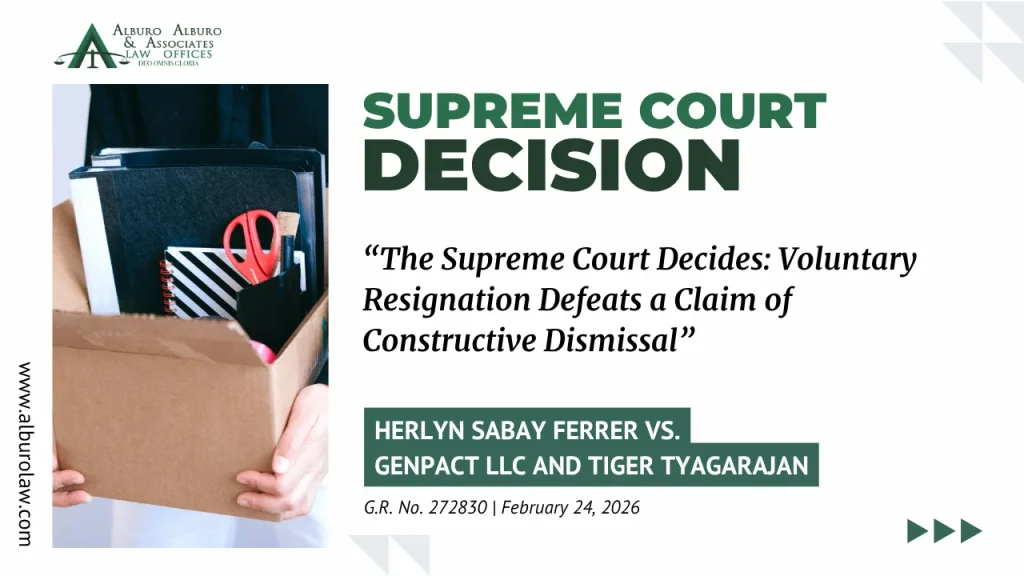
Case: Herlyn Sabay Ferrer vs. Genpact LLC and Tiger Tyagarajan (G.R. No. 272830 | February 24, 2026)
Related article: Involuntary Resignation – A Form of Constructive Dismissal
Click here to subscribe to our newsletter
Alburo Alburo and Associates Law Offices specializes in business law and labor law consulting. For inquiries regarding legal services, you may reach us at info@alburolaw.com, or dial us at (02)7745-4391/ 09175772207/ 09778050020.
All rights reserved.