

AT A GLANCE:
An employee who solicits and receives money from a telephone applicant by falsely representing that it is a down payment for the installation of a telephone line commits serious misconduct warranting dismissal. The Supreme Court held that the employer need only establish the employee’s misconduct by substantial evidence, and due process is satisfied when the employee is given notice and a meaningful opportunity to explain his side.
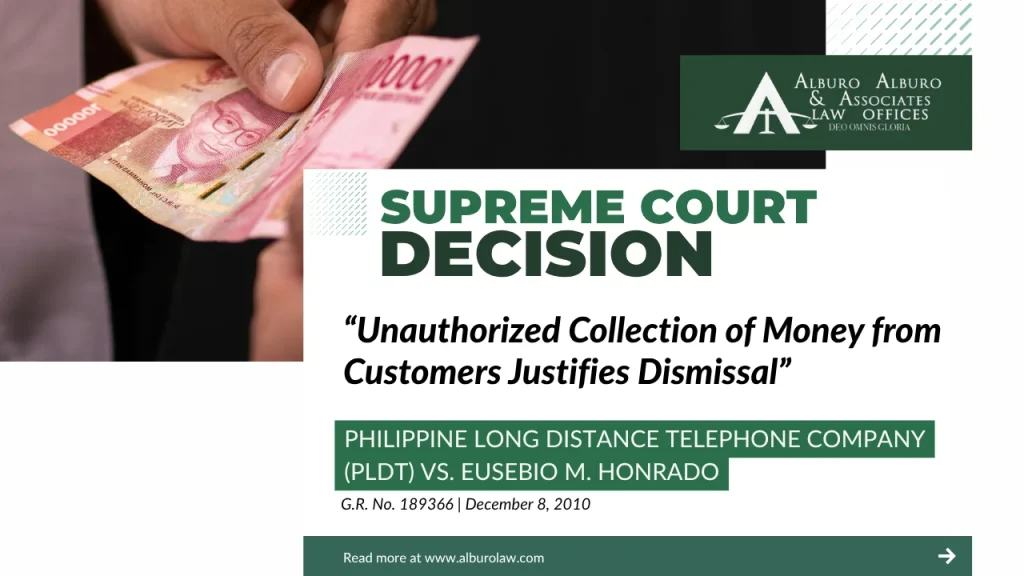
On November 26, 1999, Spouses Pete and Rodrigo Mueda were visited by a man who introduced himself as a PLDT employee. He represented that their telephone application could be prioritized if they paid him PhP1,500.00 as partial payment for the installation of their telephone line. Believing his representations, the spouses handed him the money, and he issued a receipt.
When the spouses later verified the transaction with PLDT, they found out that the act of soliciting and receiving ₱1,500.00 as down payment for installation of a new telephone line was against PLDT policy.
On January 18, 2000, a stake-out operation was conducted at the PLDT North Parañaque Exchange to determine the identity of Rony Hipolito. When Honrado handed his Trip Authorization Pass to the guard on duty at the gate, Mrs. Mueda positively identified him as the person who solicited and received the money from her and her husband.
On January 19, 2000, a confrontation proceeding between Honrado and Mrs. Mueda was conducted. Mrs. Mueda categorically declared, in the presence of Honrado, that he solicited and received ₱1,500.00 from her as down payment for the installation of her new telephone line. Honrado opted not to give any statement at the proceeding but was thereafter given an opportunity to explain his side.
PLDT later notified Honrado of the formal charges against him and required him to explain in writing “why [he] should not be dismissed for serious misconduct.” Honrado denied all the allegations and requested a formal hearing with the assistance of his lawyer and Union official. The formal hearing was thereafter conducted with their assistance. His counsel asked to examine the receipt and to cross-examine Mrs. Mueda, but the requests were denied.
PLDT subsequently found Honrado liable as charged and dismissed him from service due to gross misconduct.
The Labor Arbiter dismissed Honrado’s complaint for illegal dismissal. The NLRC reversed and ordered his reinstatement with full backwages. The Court of Appeals affirmed the NLRC.
PLDT then elevated the case to the Supreme Court.
The issue in this case is whether Honrado was validly dismissed for serious misconduct and whether he was afforded due process.
The Supreme Court GRANTED the petition.
The Court reiterated that the requisites for a valid dismissal are:
- the employee must be afforded due process, i.e., he must be given an opportunity to be heard and defend himself; and
- the dismissal must be for a valid cause as provided in Article 282 of the Labor Code or for any of the authorized causes under Articles 283 and 284 of the same Code.
It is hornbook in employee dismissal cases that the essence of due process is an opportunity to be heard, or as applied to administrative proceedings, an opportunity to explain one’s side. A formal or trial type hearing is not at all times and in all instances essential to due process, the requirements of which are satisfied where the parties are afforded fair and reasonable opportunity to explain their side of the controversy. Neither is it necessary that the witnesses be cross-examined by counsel for the adverse party.
In this case, a confrontation proceeding between Honrado and Mrs. Mueda was conducted, during which Mrs. Mueda identified Honrado and declared that he solicited and received the PhP1,500.00 downpayment from her. Honrado was thereafter apprised of the formal charges against him, given an opportunity to explain his side, and afforded a formal hearing with the assistance of his lawyer and Union representative.
The Court thus held that “Honrado was afforded ample opportunity to air his side and defend himself. Hence, there was no denial of his right to due process.”
On the issue of just cause, Mrs. Mueda categorically declared in the presence of Honrado that he solicited and received PhP1,500.00 from her as downpayment for the installation of her telephone line. This fact was corroborated by the unnotarized affidavits of the spouses Mueda and the receipt issued for the PhP1,500.00 downpayment.
Honrado, on the other hand, merely denied the accusations and submitted affidavits to establish his alibi. However, the Court did not give credence to the affidavits. In his Reply filed with the Labor Arbiter, Honrado indicated that he reported for work at 6:00 p.m. Thus, the Labor Arbiter correctly found that he could not have been in PLDT Village, Biñan, Laguna shortly after 6:00 p.m. or around 6:30 p.m. as claimed in the separate affidavits.
Time and again, the Court has held that positive identification of the respondent were categorical and consistent, without any showing of ill motive on the part of the eyewitness, should prevail over the alibi and denial of the respondent and his witnesses whose testimonies are conflicting and not substantiated.”
The Court likewise reiterated that the quantum of proof required in determining the legality of an employee’s dismissal is only substantial evidence. The standard is met where the employer has reasonable ground to believe that the employee is responsible for the misconduct and his participation in such misconduct makes him unworthy of the trust and confidence demanded by his position.
In this case, PLDT sufficiently established that Honrado solicited, collected and received the PhP1,500.00 downpayment from the spouses Mueda.
First, during the January 18, 2000 stake-out operation, Honrado was identified by Mrs. Mueda when he handed his Trip Authorization Pass to the guard on duty at the PLDT North Parañaque Exchange gate.
Second, Mrs. Mueda categorically affirmed during the January 19, 2000 confrontation proceeding that it was indeed Honrado who solicited and received the ₱1,500.00 downpayment for the installation of her new telephone line.
Third, corroborating evidence in the form of the affidavits of the spouses Mueda was submitted by PLDT, together with the receipt issued for the downpayment.
Taken together, the petitioner has dispensed with the burden of establishing the serious misconduct committed by respondent Honrado. Such misconduct makes him unworthy of the trust and confidence demanded by his position.
Accordingly, the Court set aside the Decision and Resolution of the Court of Appeals and reinstated and affirmed the Decision of the Labor Arbiter dated October 19, 2001 dismissing the complaint for lack of merit.
Related article: What Are the Procedural Requirements in Dismissing an Employee Based on Just Causes?
Click here to subscribe to our newsletter
Alburo Alburo and Associates Law Offices specializes in business law and labor law consulting. For inquiries regarding legal services, you may reach us at info@alburolaw.com, or dial us at (02)7745-4391/ 09175772207/ 09778050020.
All rights reserved.