
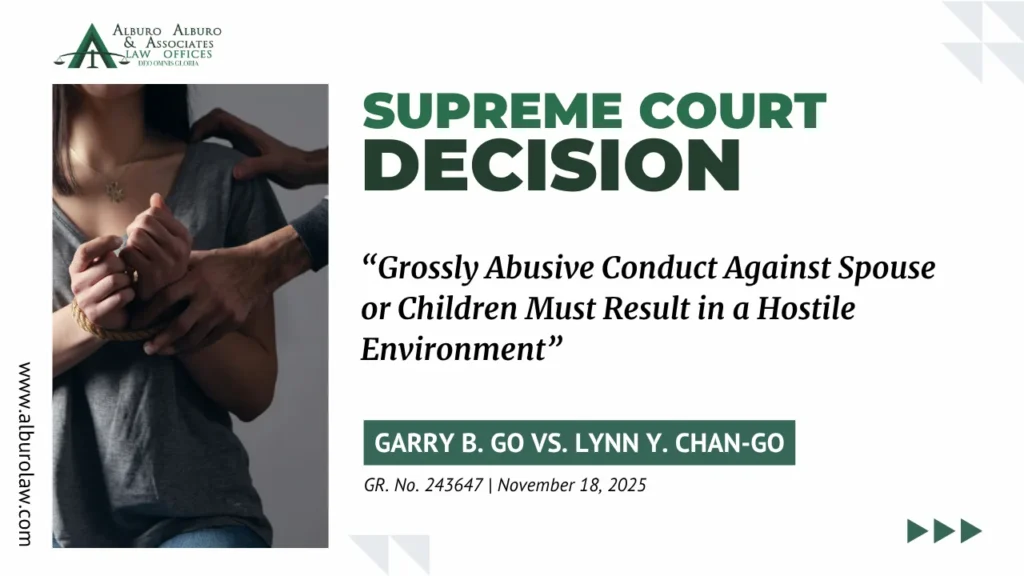
Photo from Unsplash | Sasun Bughdaryan
This article is provided for general informational purposes only and does not create, nor shall it be construed as creating, a lawyer-client relationship between Alburo Alburo and Associates Law Offices (or any of its lawyers) and the reader. For advice on specific legal concerns, you are encouraged to engage the services of a qualified lawyer. You may also directly consult Alburo Alburo and Associates Law Offices for proper guidance tailored to your situation.
The views and information presented herein are based on the laws, rules, and jurisprudence prevailing at the time of writing. They do not take into account subsequent legal developments and should not be relied upon as a substitute for professional legal advice.
AT A GLANCE:
The Family Code provides grossly abusive conduct as a ground for legal separation, however, there exists no exact definition for the term. The Court finds that acts constituting “grossly abusive conduct” pertains to acts committed by a spouse against the other spouse, the latter’s child, or their common child which result in a hostile and intimidating environment for the other spouse, their children, and common children.
Garry and Lynn married on March 29, 2003 and had two children. To support their family, Lynn sold coffee while Garry studied nursing, with the plan of moving his family abroad. Garry’s plan fell through. Instead, he’d go on to work in Cebu and Davao.
Garry alleged that he’d experienced different forms of abusive conduct from Lynn, including her greed that caused him financial strain during his canal operation, her close-minded and untrustworthy behavior, her efforts to control and manipulate Garry and their children, her efforts to belittle Garry in front of others, and her acts of doing things without Garry’s knowledge.
Garry suggested marriage counseling, which Lynn allegedly refused. The two were separated in fact around June 2008. However, Garry returned to Cebu to give their relationship another chance. Garry alleged that Lynn became more difficult to handle. No longer tolerating her conduct, Garry transferred to Davao in August 2009.
Garry gathered testimonies that further supported the greedy and selfish character of Lynn.
Lynn argued that Garry grew irritable due to their financial issues, becoming less cooperative when providing aid for Lynn’s business, spending too much time in his study room, or going out with friends too frequently. Lastly, she stated that Garry did not send the full amount he had promised to send their family while he was working in Davao.
The RTC decreed the legal separation of the two, ruling that there was sufficient prima facie evidence to prove the existence of grossly abusive conduct.
The CA reversed the decision of the RTC, ruling the issues between Garry and Lynn to be neither grave nor abusive, and the same was not beyond repair.
The issue of the instant case is whether or not the CA erred in finding that grossly abusive conduct as a ground for legal separation was not present in this case.
The Supreme Court ruled in the affirmative.
Preliminarily, the Court notes that the issue raised by Garry is mainly factual in nature, particularly, whether the ground of grossly abusive conduct exists.
Under Rule 45 of the Rules of Court, jurisdiction is generally limited to the review of errors of law committed by the appellate court. The Supreme Court is not obliged to review all over again the evidence which the parties adduced in the court a quo. However, there are recognized exceptions to this rule, one of which is when the judgment of the lower courts is based on a misapprehension of facts. As will be explained hereunder, this exception is applicable herein.
As can be observed in the above-cited acts, the Court in Ong and Najera compounded the acts of “repeated physical violence” and “grossly abusive conduct” in finding the existence of a ground for legal separation. However, in comparison to Ong and Najera, Garry in the present case hinges his prayer for legal separation only on the ground of “grossly abusive conduct.” Considering the difference in the factual incidents and grounds as cited in Ong and Najera, on one hand, and the present case, on the other, the Court is given the opportune time to answer the question: what constitutes as “grossly abusive conduct” in the context of legal separation under the Family Code?
The Family Code and present case law do not provide for an exact definition for the term “grossly abusive conduct” under Article 55(1) of the Family Code. Considering how neither statutory nor case law provides guidance in resolving the question, it behooves the Court to look into the Minutes of the Civil Code and Family Law Committees (Code Committee) to shed some light on the matter.
Taking the Court’s discussion in Ong and Najera, the Code Committee’s understanding and commentaries on “grossly abusive conduct” referred to Article 55(1) of the .Family Code, as well as the observations from other jurisdictions, this Court thus finds that acts constituting “grossly abusive conduct” pertain to acts committed by a spouse against the other spouse, the latter’s child, or their common child which result in a hostile and intimidating environment for the other spouse, their children, and common children. ln this relation, the determination of whether “grossly abusive conduct” exists as a ground for legal separation must be determined by the courts on a case-to-case basis, taking into consideration the facts and evidence in each case. To the Court’s mind, the foregoing definition of “grossly abusive conduct” is consistent with the State’s constitutional o’ ligation to protect marriages as a basic social institution.
ln the present case, Garry hinges the existence of “grossly abusive conduct” on the following: (a) Lynn’s refusal to provide help with his toothache; (b) Lynn’s alleged acts of maligning Garry’s reputation; (c) Lynn’s refusal to seek marriage counseling; (d) Lynn’s acts of doing things without Garry’s knowledge; (e) Lynn just wanting money; (f) Lyrm not liking his friends and prohibiting him from seeing them; (g) Lynn not trusting people; (h) Lynn being a closed-minded person who believes that she is always right; and (i) Lynn manipulating her children and using them to compel Garry to provide more support.
To the Court’s mind, Garry’s allegations against Lynn satisfy the existence of a hostile and intimidating environment for Garry. As can be gleaned from the facts, Lynn’s treatment of Garry subjected him from always taking Lynn’s lead. Moreover, there were numerous attempts made by Garry to save their marriage through counseling and interventions, which were nonetheless made futile. Furthermore, the testimonies of his witnesses further support the existence of a hostile environment as reflected by Lynn’s controlling attitude. Thus, the Court cannot find fault in Garry’s decision to be reassigned back to Davao for work to be away from the environment in Cebu.
Taken together, the Court finds that Garry was able to prove that Lynn’s acts constituted “grossly abusive conduct” under the Family Code. Thus, the Court deems it proper to reverse the findings of the CA and reinstate the RTC Decision granting a decree of legal separation between Garry and Lynn.
Source: Garry B. Go vs. Lynn Y. Chan-Go (GR. No. 243647 | November 18, 2025)
Related article: What is considered as Economic Abuse under the Anti-VAWC Act?
Click here to subscribe to our newsletter
Alburo Alburo and Associates Law Offices specializes in business law and labor law consulting. For inquiries regarding legal services, you may reach us at info@alburolaw.com, or dial us at (02)7745-4391/ 09175772207/ 09778050020.
All rights reserved.