
Photo from Unsplash | Mina Rad
The following post does not create a lawyer-client relationship between Alburo Alburo and Associates Law Offices (or any of its lawyers) and the reader. It is still best for you to engage the services of a lawyer or you may directly contact and consult Alburo Alburo and Associates Law Offices to address your specific legal concerns, if there is any.
Also, the matters contained in the following were written in accordance with the law, rules, and jurisprudence prevailing at the time of writing and posting, and do not include any future developments on the subject matter under discussion.
AT A GLANCE:
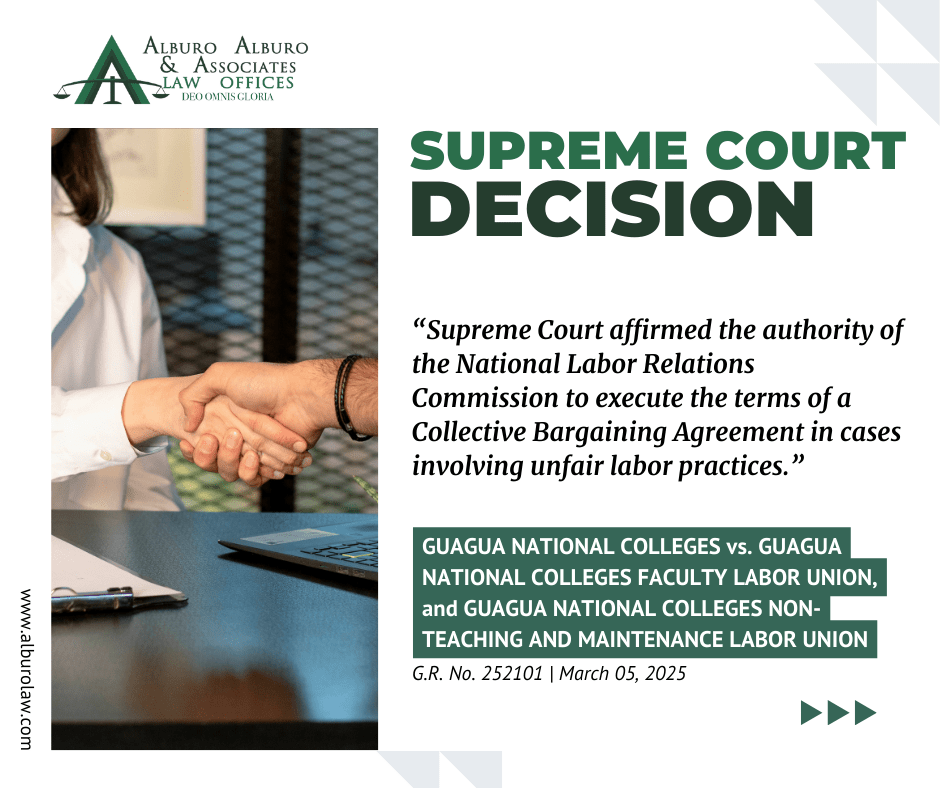
The power to enforce the terms of the Collective Bargaining Agreement, including the redress of perceived violations thereof, does not reside exclusively with the voluntary arbitrators. The Labor Code itself recognizes that the National Labor Relations Commission may exercise jurisdiction when it involves gross violations of CBAs as to amount to unfair labor practice.
Guagua National Colleges (GNC) is an educational institution in Sta. Filomena, Guagua, Pampanga, wherein GNCFLU and GNCNTMLU (collectively, the unions) are the designated bargaining agents of the school’s teaching and non-teaching personnel. Between 1994 and 2009, the parties entered into three Collective Bargaining Agreement (CBA)s that covered both unions.
On April 3, 2009, the unions signified their intent to negotiate the renewal of the CBA which was then in effect and set to expire on May 31, 2009. Instead of submitting a reply or counterproposal, GNC called for a meeting on May 15, 2009 for negotiations. No agreement was reached.
However, what the unions received next was not a notice for the next meeting, but a letter dated May 27, 2009 from GNC stating that the school’s management was not inclined to grant the monetary proposals submitted by the unions.
Thereafter, the parties engaged in several meetings. On August 24, 2009, the representative of GNC confirmed the benefits to be included in the new CBA: loyalty pay, cash gift, rice subsidy, birthday gift, and clothing allowance, but did not accede to the unions’ demand for an increased signing bonus. Despite this, no signing took place and the parties no longer came to an agreement.
Hence, the unions filed a preventive mediation case before the National Conciliation and Mediation Board (NCMB). Later, they filed a notice of strike charging GNC with bad faith bargaining, violation of its duty to bargain, and diminution of benefits. Nonetheless, the strike was averted after the Secretary of Labor and Employment assumed jurisdiction and certified the case to the National Labor Relations Commission (NLRC) for compulsory arbitration.
The NLRC rendered its Decision dated March 31, 2011 finding GNC to have committed unfair labor practice by not bargaining in good faith. The NLRC declared the final draft of the CBA as the actual CBA between the parties effective June 1, 2009 to May 31, 2014, with the benefits agreed upon as of August 24, 2009 to be given retroactive effect as of June 1, 2009.
The Decision became final and executory. Still, GNC challenged the foregoing ruling all the way to this Court. The case was docketed as G.R. No. 204693 entitled, Guagua National Colleges v. Guagua National Colleges Faculty Labor Union, wherein the Court affirmed the NLRC ruling that the final draft submitted should serve as the parties’ CBA.
After the decision became final, the unions moved to execute the NLRC judgment. The NLRC issued a writ of execution ordering GNC to pay monetary awards covering unimplemented economic benefits under the CBA such as rice subsidy, longevity pay, emergency relief allowance, and signing bonus.
The Court of Appeals (CA) partly granted the petition by excluding the signing bonus but maintained the awards for rice subsidy, longevity pay, and emergency relief allowance.
Dissatisfied, both parties moved for partial reconsideration. In the Amended Decision, the CA still maintained the modified award in favor of the unions, but nevertheless clarified that they are not required to reimburse any amount to GNC received as “signing bonus,” considering that the latter denied ever giving such bonus to the former.
Aggrieved, GNC filed the present Petition.
The issue in this case is whether the CA err in upholding the writ of execution issued against GNC.
The Supreme Court partly granted the petition.
The jurisdiction of the NLRC is enshrined under Article 224 of the Labor Code and includes complaints for unfair labor practice cases and cases involving violations to the duty to bargain collectively under Article 264. It likewise may take cognizance of labor disputes certified by the Secretary of Labor and Employment for compulsory arbitration cases. However, cases arising from the interpretation or implementation of a CBA must be referred to the grievance machinery and voluntary arbitration per the terms of the said agreement.
The Court held that the NLRC may execute the provisions of a CBA if the nature of the action it proceeds from is a certified compulsory arbitration stemming from alleged unfair labor practice and violations to the duty to bargain collectively under Article 264. The power to enforce the terms of the CBA, including the redress of perceived violations thereof, does not reside exclusively with the voluntary arbitrators. The Labor Code itself recognizes that the NLRC may exercise jurisdiction when it involves gross violations of CBAs as to amount to unfair labor practice.
A grant of jurisdiction, barring prohibitive legislation, implies the necessary and usual incidental powers essential to effectuate it — also referred to as ‘incidental jurisdiction. This attaches to the tribunal upon conferment of jurisdiction over the main case and includes the power and authority of an office or tribunal to do all things reasonably necessary for the administration of justice within the scope of its jurisdiction, and for the enforcement of its judgment and mandates.”
Indeed, the power of the NLRC to execute its rulings is not a blind ministerial act. In fact, its power carries with it the right to look into the correctness of the execution of the decision and to consider supervening events that may affect such execution. Necessarily, it would better promote the ends of justice to recognize the authority of the NLRC to continue to enforce the provisions of the CBA which GNC has been reluctant to adhere to.
Since the NLRC found GNC guilty of unfair labor practice and declared the final draft of the CBA as the governing CBA between the parties for 2009 to 2014, it stands to reason that it would be in the best position to enforce the same.
However, the NLRC acted in excess of its jurisdiction in two respects.
First, the signing bonus cannot be awarded. A signing bonus is a grant motivated by the goodwill generated when a CBA is successfully negotiated and signed between the employer and the union. In this case, no CBA was successfully negotiated by the parties because the CBA was only imposed by the NLRC.
Second, the NLRC erred in computing the benefits beyond May 31, 2014. The decision being executed implemented a CBA intended to govern the relationship of the parties between June 1, 2009 and May 31, 2014. Extending the benefits beyond this period altered a final and executory decision and violated the doctrine of immutability of judgments.
Applied to the case at bench, the NLRC should confine its computation of benefits up to May 31, 2014 only. Any dispute as to the economic benefits awardable after said date, including the covered employees thereof, should undergo the usual grievance machinery and referral to voluntary arbitration as contained in the parties’ CBA.
Click here to subscribe to our newsletter
Alburo Alburo and Associates Law Offices specializes in business law and labor law consulting. For inquiries regarding legal services, you may reach us at info@alburolaw.com, or dial us at (02)7745-4391/ 09175772207/ 09778050020.
All rights reserved.