

Photo from Unsplash | Tingey Injury Law
The following post does not create a lawyer-client relationship between Alburo Alburo and Associates Law Offices (or any of its lawyers) and the reader. It is still best for you to engage the services of a lawyer or you may directly contact and consult Alburo Alburo and Associates Law Offices to address your specific legal concerns, if there is any.
Also, the matters contained in the following were written in accordance with the law, rules, and jurisprudence prevailing at the time of writing and posting, and do not include any future developments on the subject matter under discussion.
AT A GLANCE:
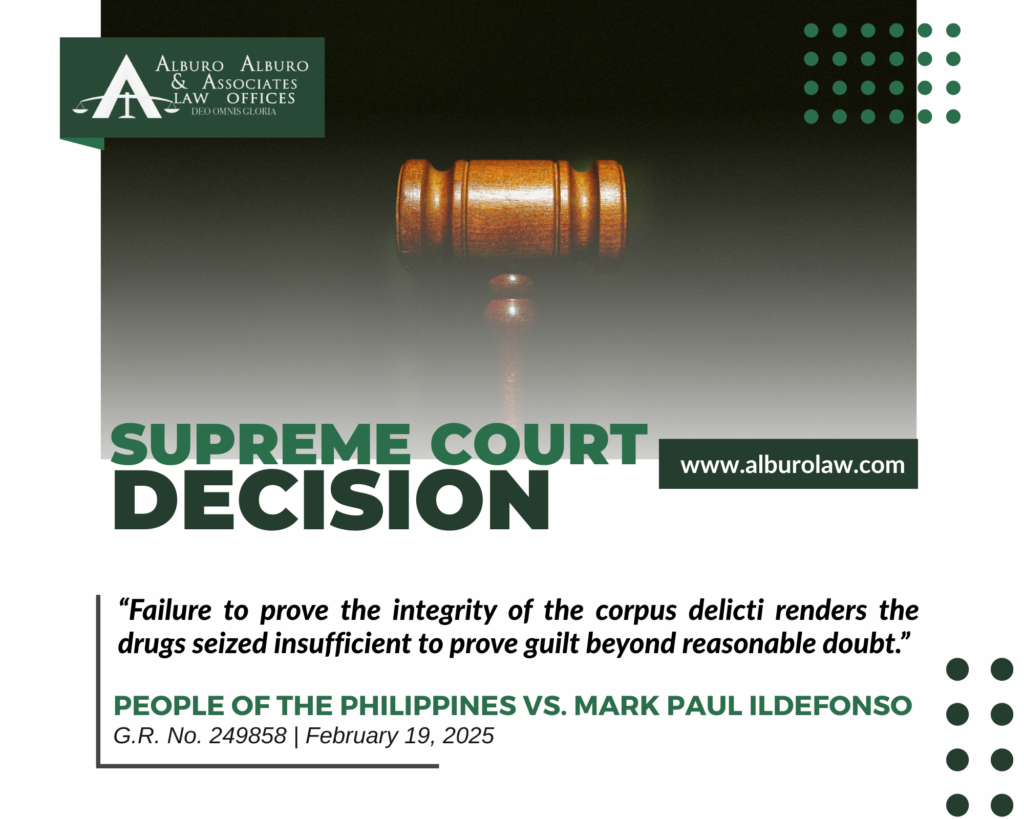
In ascertaining the liability of accused-appellant for violation of Republic Act No. 9165, it is imperative to determine whether the identity of the dangerous drugs allegedly confiscated from him were established with moral certainty. The dangerous drugs form an integral part of the corpus delicti of the crime. Failure to prove the integrity of the corpus delicti renders the drugs seized insufficient to prove his guilt beyond reasonable doubt. Thus, warranting his acquittal.
The Supreme Court Decides: Each link in the chain of custody must be established to ensure that the integrity and evidentiary value of the seized items are preserved.
The case stemmed from three (3) Informations filed against Mark Paul Ildefonso for violation of
COMELEC Resolution No. 9561-A, in relation to COMELEC Resolution No. 9735 and the Omnibus Election Code; and Sections 5 and 11 of Republic Act (R.A.) No. 9165. The portions of the Informations read:
- Criminal Case No. 15711-13 for violation of Section 5 of R.A. No. 9165
- Criminal Case No. 15712-13 for violation of Section 11 of R.A. No. 9165
- Criminal Case No. 15710-65 for violation of COMELEC Resolution No. 9561-A, in relation to COMELEC Resolution No. 9735 and the Omnibus Election Code
The Regional Trial Court (RTC) convicted Ildefonso of the crimes charged against him. In convicting Ildefonso of violation of Sections 5 and 11 of Republic Act No. 9165, the RTC found
that the elements of illegal sale and illegal possession of dangerous drugs were proven beyond reasonable doubt through the testimonies of the members of the buy-bust team, and the documents issued in relation to the operation. As regards the knife that was confiscated from Ildefonso, the RTC found that the elements for violation of the election ban on carrying of firearm or any deadly weapon were duly proven.
The Court of Appeals (CA) affirmed with modification the conviction of Ildefonso. In upholding the conviction of Ildefonso for violation of Sections 5 and 11 of R.A. No. 9165, the CA found that the buy-bust team substantially complied with the chain of custody rule and preserved the integrity and evidentiary value of the confiscated items. Hence, this appeal.
The issue in this case is whether or not the integrity and evidentiary value of the dangerous drugs allegedly seized from Ildefonso were properly preserved in compliance with Section 21 of R.A. No. 9165.
The Supreme Court Decides
The Supreme Court granted the appeal. Accused-appellant is acquitted in Criminal Case Nos. 15711-13 and 15712-13 for violation of Sections 5 and 11 of R.A. No. 9165, respectively. He is also acquitted in Criminal Case No. 15710-65 for violation of COMELEC Resolution No. 9561-A, in relation to COMELEC Resolution No. 9735 and the Omnibus Election Code.
The integrity and evidentiary value of the dangerous drugs allegedly seized from accused-appellant were not properly preserved in compliance with Section 21 of R.A. No. 9165.
Each link in the chain of custody must be established to ensure that the integrity and evidentiary value of the seized items are preserved. Here, the first link in the chain of custody was not sufficiently established. Since the first link in the chain of custody is unreliable, examining the subsequent links is no longer necessary. The prosecution failed to prove compliance with the stringent rules governing the chain of custody as the first link was not established with moral certainty. Thus, accused-appellant must be acquitted of violation of Sections 5 and 11 of R.A. No. 9165.
The Court reiterated that COMELEC exceeded the scope of its legislative authority when it included bladed instruments in the term “deadly weapons.” It was not the intention of the legislature to make possession and carriage of bladed instruments during election period punishable. Thus, Section 2(c), in relation to Section 1(a) of COMELEC Resolution No. 9561-A, is void insofar as it includes “bladed instruments” in the definition of “deadly weapons.” As such, accused-appellant must be acquitted of the charge for violation of COMELEC Resolution No. 9561-A, in relation to COMELEC Resolution No. 9735 and the Omnibus Election Code.
Source:
Click here to subscribe to our newsletter
Alburo Alburo and Associates Law Offices specializes in business law and labor law consulting. For inquiries regarding legal services, you may reach us at info@alburolaw.com, or dial us at (02)7745-4391/ 09175772207/ 09778050020.
All rights reserved.