

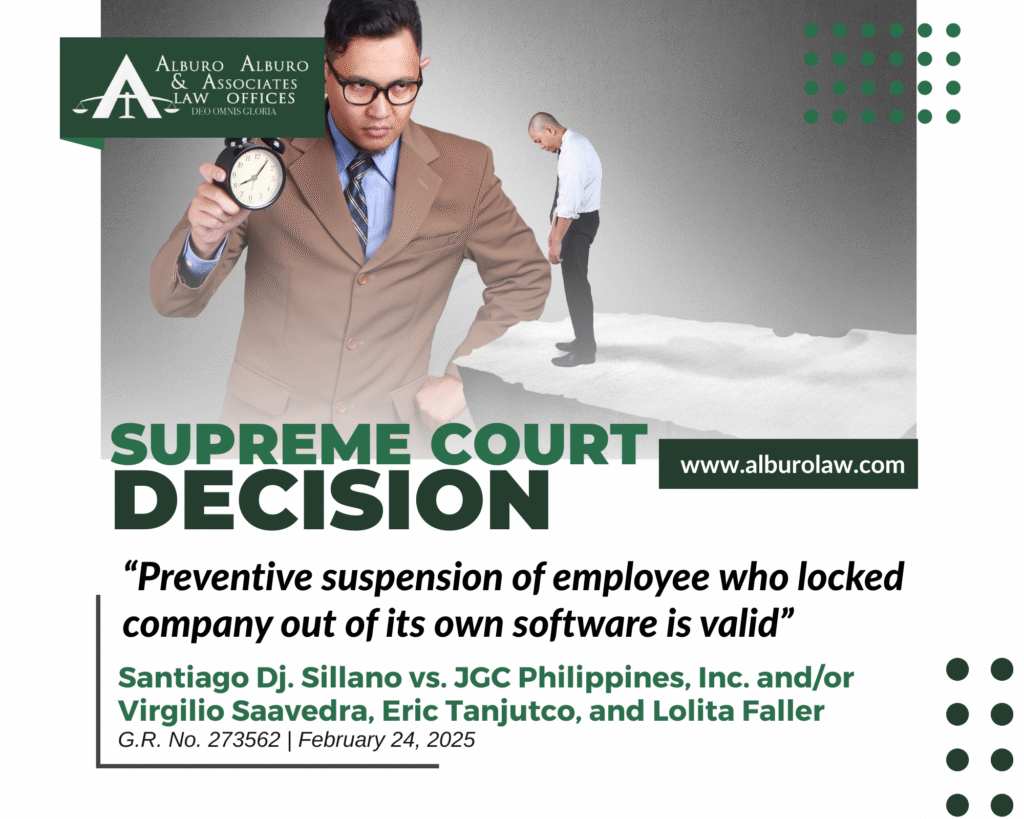
Photo from Canva free photo
The following post does not create a lawyer-client relationship between Alburo Alburo and Associates Law Offices (or any of its lawyers) and the reader. It is still best for you to engage the services of a lawyer or you may directly contact and consult Alburo Alburo and Associates Law Offices to address your specific legal concerns, if there is any.
Also, the matters contained in the following were written in accordance with the law, rules, and jurisprudence prevailing at the time of writing and posting, and do not include any future developments on the subject matter under discussion.
AT A GLANCE:
Preventive suspension is not a penalty but a disciplinary measure to protect life or property of the employer or the co-workers pending investigation of any alleged infraction committed by the employee. Thus, it is justified only when the employee’s continued employment poses a serious and imminent threat to the employer’s or co-workers’ life or property. When justified, the preventively suspended employee is not entitled to the payment of his salaries and benefits for the period of suspension.
JGC Philippines, Inc. (JGC) is engaged in the business of design engineering and construction management. On June 1, 1994, it employed Sillano as Junior Engineer.
During his employment with JGC, Sillano developed various computer programs. Consequently, Sillano and JGC began their dispute as to the ownership of the subject computer programs. Sillano claimed that as the program’s creator, he owned the same; while JGC, on the other hand, countered that it was the owner since Sillano created them within the course of his employment with the company. According to JGC, any work product of an employee during the period of employment automatically becomes its property.
Thereafter, Sillano activated the security features of the program, making them inaccessible and ineffective for JGC’s business projects.
JGC served upon Sillano a Notice to Explain and Notice of Preventive Suspension to Sillano, as well as a demand letter and a final demand letter directing Sillano to unlock the security features of the subject computer programs.
Considering that Sillano did not obey JGC’s demand to unlock the security features of the computer programs, JGC decided to terminate him for:
(1) violating company rules and policies in total disregard of his superior’s authority;
(2) deliberately refusing direction orders to unlock and surrender the source codes of the subject computer programs.
In view of his termination, Sillano filed a complaint before the NLRC and sought relief for illegal dismissal; illegal suspension; unpaid wages; actual, moral, and exemplary damages; and attorney’s fees.
The Labor Arbiter ruled that Sillano’s dismissal is with a just cause and that the procedural due process was complied with.
The NLRC reversed the Labor Arbiter’s Decision and held that Sillano’s preventive suspension was valid but nevertheless he was illegally dismissed. Anent the issue of preventive suspension, the CA held that NLRC correctly ruled that Sillano’s preventive suspension was valid. It complied with all the requisites provided in our jurisprudence. The ownership of the computer program was not yet ascertained at the time of the suspension. Thus, Sillano’s acts to restrict access to the same posed a serious and imminent threat to what his employer, JGC, deemed to be its property pending investigation and a definitive ruling from IPO on the copyright ownership of the subject programs. Moreover, there was no showing that the preventive suspension exceeded the maximum 30-day period provided by law.
The CA affirmed the NLRC’s decision.
Is the CA correct in affirming the NLRC’s decision that Sillano’s preventive suspension was valid?
Sillano also argues that the CA modified the IPO ruling when it ruled that his preventive suspension was valid. IPO held that copyright subsists from the time of the creation of the programs, which is from 2001 to 2003. Thus, when Sillano was preventively suspended in 2004, he was already the owner of the copyright and thus, the suspension has no basis. Assuming that ownership is still to be ascertained, then applying the equipoise rule, it must favor him as the employee. Sillano further states that his preventive suspension lasted more than 30 days.
The Supreme Court Decides
Sillano’s preventive suspension was valid. The requirements for a valid imposition of preventive suspension were complied with in the present case. Preventive suspension is not a penalty but a disciplinary measure to protect life or property of the employer or the co-workers pending investigation of any alleged infraction committed by the employee. Thus, it is justified only when the employee’s continued employment poses a serious and imminent threat to the employer’s or co-workers’ life or property. When justified, the preventively suspended employee is not entitled to the payment of his salaries and benefits for the period of suspension.
To reiterate, at the time when JGC imposed the preventive suspension, there was still no IPO ruling on who is the owner of the subject programs. As such, when JGC, acting as the owner of the subject programs, was asking for the turnover of the source codes from Sillano and he did not obey, it was viewed as a serious and imminent threat to their property as their access was restricted. Thus, at the time when Sillano was preventively suspended, JGC has a valid ground to do so.
The CA also correctly ruled that the preventive suspension did not exceed the 30-day limit provided under the Labor Code. As stated in Section 9 of the Omnibus Rules Implementing the Labor Code, “No preventive suspension shall last longer than 30 days. The employer shall thereafter reinstate the worker in his former or in a substantially equivalent position or the employer may extend the period of suspension provided that during the period of extension, he pays the wages and other benefits due to the worker.”
Sillano was preventively suspended starting on January 14, 2004, when he received the Notice to Explain and Notice of Preventive Suspension. On February 16, 2004, Sillano was terminated. It must be noted that the 30-day period ended on a Friday, February 13, 2004. Thus, immediately on the next working day, which is February 16, 2004 (Monday), JGC already resolved the issue and terminated Sillano’s employment. Taking note of this circumstance, this Court agrees with the CA that it is still within the prescribed period.
Click here to subscribe to our newsletter
Alburo Alburo and Associates Law Offices specializes in business law and labor law consulting. For inquiries regarding legal services, you may reach us at info@alburolaw.com, or dial us at (02)7745-4391/ 09175772207/ 09778050020.
All rights reserved.