
Photo from Unsplash | Sasun Bughdaryan
The following post does not create a lawyer-client relationship between Alburo Alburo and Associates Law Offices (or any of its lawyers) and the reader. It is still best for you to engage the services of a lawyer or you may directly contact and consult Alburo Alburo and Associates Law Offices to address your specific legal concerns, if there is any.
Also, the matters contained in the following were written in accordance with the law, rules, and jurisprudence prevailing at the time of writing and posting, and do not include any future developments on the subject matter under discussion.
AT A GLANCE:
The Supreme Court ruled that in drug-related cases, prosecutors are required to present all their objections to a proposed plea bargain at once; otherwise, any grounds not mentioned will be deemed waived.
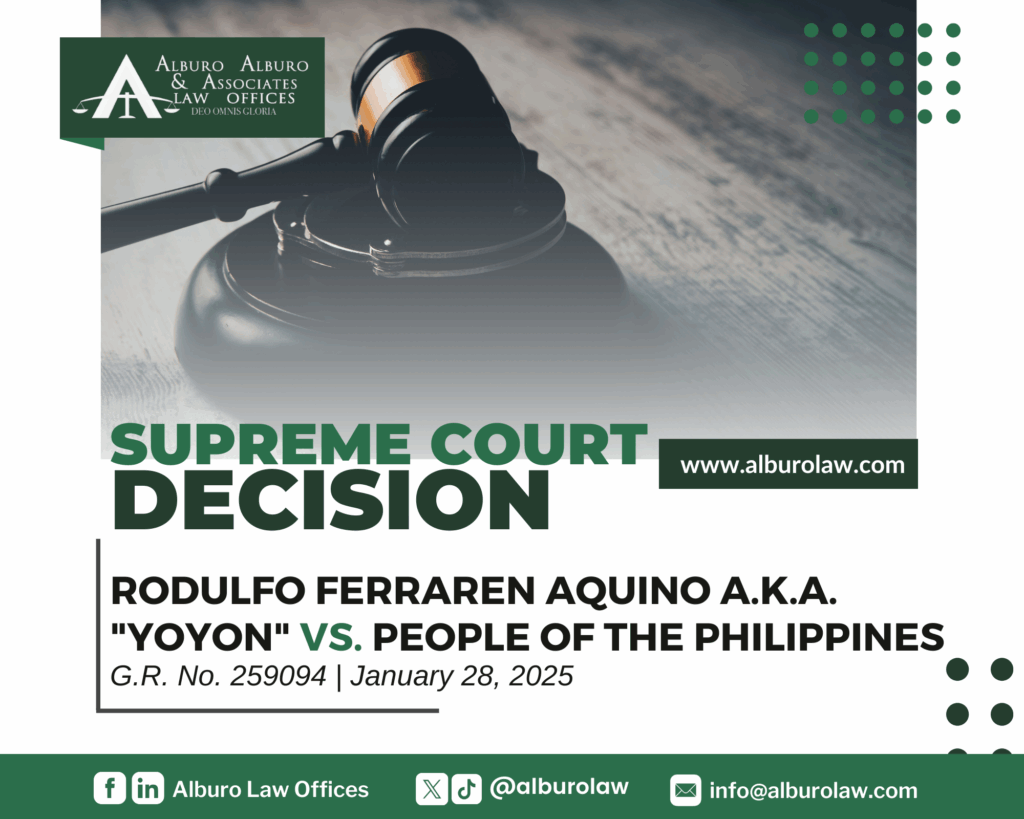
In the case of Rodulfo Ferraren y Aquino a.k.a. “Yoyon” v. People of the Philippines, promulgated January 28 of this year, Aquino was charged in two separate Informations for (1) illegal sale of dangerous drugs (Criminal Case No. 2019-26185) and (2) illegal possession of dangerous drugs (Criminal Case No. 2019-26186), both allegedly committed on May 21, 2019 in Dumaguete City. The first case involved 0.18 grams of shabu, while the second involved 1.84 grams.
Aquino pleaded not guilty but filed a motion for plea bargaining, proposing to plead guilty to the lesser offense of illegal possession of drug paraphernalia under Section 12 of Republic Act No. 9165. He cited A.M. No. 18-03-16-SC, the Supreme Court’s Plea Bargaining Framework in Drug Cases.
The prosecution opposed the plea bargain for the illegal sale charge, citing DOJ Department Circular No. 027 which prohibited plea bargaining from Section 5 (sale) to Section 12 (paraphernalia). Nonetheless, the RTC granted the motion and allowed Aquino to plead guilty to two counts of Section 12 violations. The RTC found that the quantity of drugs involved fell within the acceptable limits under the Supreme Court’s framework.
After a joint judgment was issued convicting Aquino of the lesser offenses, the prosecution moved for reconsideration, which the RTC denied. The OSG then filed a petition for certiorari before the Court of Appeals. The CA granted the petition and annulled the RTC’s rulings, emphasizing that the prosecution’s consent remained essential under Rule 116, Section 2 of the Rules of Court.
With this, Aquino elevated the case to the Supreme Court.
THE SUPREME COURT DECIDES
The Supreme Court granted Aquino’s petition and reversed the CA’s decision. It ruled that a trial court may overrule the prosecution’s objection to a plea bargain in drug cases if the objection is based solely on DOJ internal rules that contradict the Supreme Court’s framework.
Citing People v. Montierro, the Court reaffirmed that the discretion to approve plea bargains lies with the courts, and that administrative issuances of the DOJ cannot override the judiciary’s exclusive constitutional rule-making power. The Court noted that DOJ Department Circular No. 027 had already been revoked by DOJ Department Circular No. 18, which now allows plea bargaining from Section 5 to Section 12 violations.
Nonetheless, the Court emphasized that a trial court’s discretion is not absolute. It must consider if the accused is a recidivist, habitual offender, drug dependent, or if the evidence of guilt is strong. In this case, the RTC failed to make such findings.
Thus, while the Court upheld the RTC’s authority to approve the plea bargain, it remanded the case for the RTC to determine if Aquino is qualified for plea bargaining under the Montierro guidelines.
To avoid delays caused by remanding cases where the prosecution failed to raise all possible grounds for objection, the Court also adopted supplementary rules:
- Where the prosecution’s objection to an accused’s motion for plea bargaining is grounded on only a few but not all possible grounds for opposing the motion, it is understood that the prosecution is waiving the grounds not thus raised..
- Where the prosecution has raised multiple grounds in its opposition, but the trial court only ruled in one but was silent with regard to the rest, the trial court shall be directed to rule on such pending issues in accordance with the principles in Montierro and this case.
- Where the records before the Court are incomplete to determine if it falls in any of the preceding scenarios, the trial court shall be directed to rule again on the matter following the principles laid down in Montierro and this case.
Ultimately, the Supreme Court reinstated the RTC’s May 30, 2019 Order and the Joint Judgment convicting Aquino of the lesser offenses, but remanded the case for further proceedings on whether he is qualified to benefit from plea bargaining under the criteria set in Montierro.
Source:
- SC Updates Plea Bargaining Guidelines in Drug Cases, Requires Prosecution to Raise All Grounds for Objections or Waive Them
- Rodulfo Ferraren Aquino a.k.a. “YOYON” vs. People of the Philippines (G.R. No. 259094 | January 28, 2025)
Click here to subscribe to our newsletter
Alburo Alburo and Associates Law Offices specializes in business law and labor law consulting. For inquiries regarding legal services, you may reach us at info@alburolaw.com, or dial us at (02)7745-4391/ 09175772207/ 09778050020.
All rights reserved.