
Photo from Pexels | Matthias Zomer
The following post does not create a lawyer-client relationship between Alburo Alburo and Associates Law Offices (or any of its lawyers) and the reader. It is still best for you to engage the services of a lawyer or you may directly contact and consult Alburo Alburo and Associates Law Offices to address your specific legal concerns, if there is any.
Also, the matters contained in the following were written in accordance with the law, rules, and jurisprudence prevailing at the time of writing and posting, and do not include any future developments on the subject matter under discussion.
AT A GLANCE:
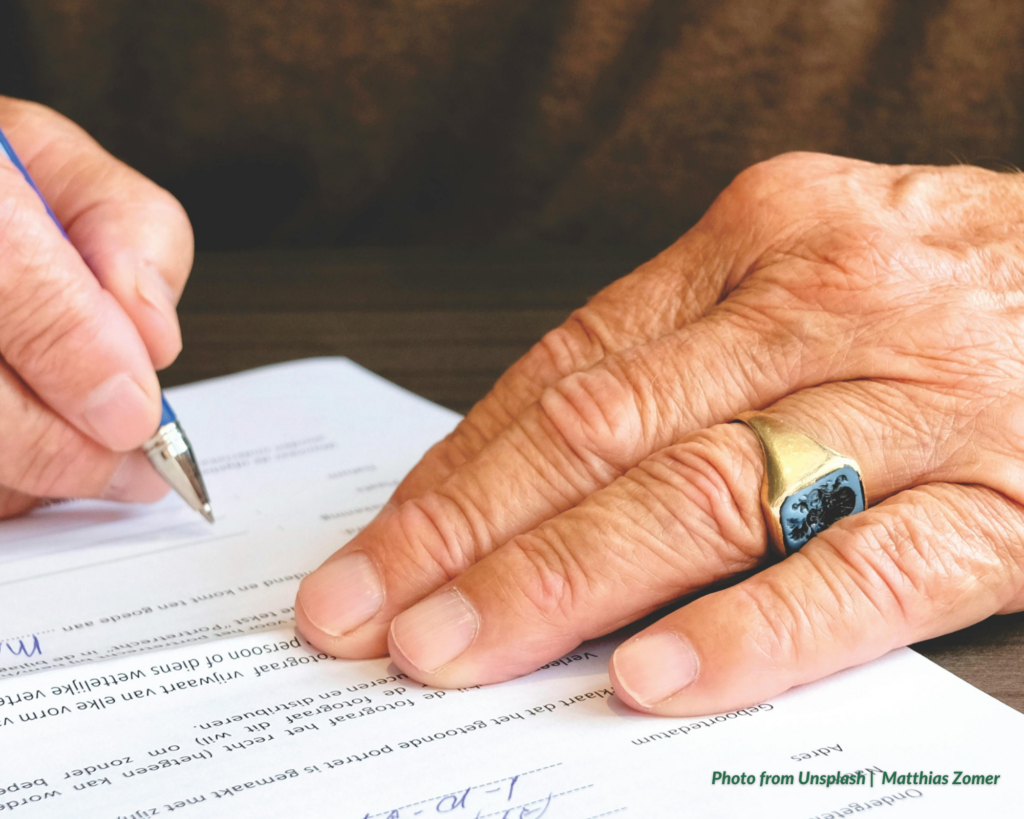
In the case of TOMAS N. OROLA AND PHIL. NIPPON AOI INDUSTRY, INC. VS. ATTY. ARCHIE S. BARIBAR, A.C. No. 6927, March 14, 2018, the Supreme Court emphasized the importance and purpose of notarization. It said that notarization is not an empty, meaningless, or routinary act. It is impressed with substantial public interest, and only those who are qualified or authorized may act as such. It is not a purposeless ministerial act .of acknowledging documents executed by parties who. are willing to pay fees for notarization. Notarization of documents ensures the authenticity and reliability of a document. Notarization of a private document converts such document into a public one, and renders it admissible in court without further proof of its authenticity. Courts, administrative agencies and public at large must be able to rely upon the acknowledgment executed by a notary public and appended to a private instrument.
Can a notary public notarize a document even if the persons who executed the said document do not appear before him or her?
No. In the aforesaid case, the Court explained that a notary public should not notarize a document unless the persons who signed the same are the very same persons who executed and personally appeared before him to attest to the contents and truth of what are stated therein. It is his duty to demand that the document presented to him for notarization be signed in his presence. The purpose of the requirement of personal appearance by the acknowledging party before the notary public is to enable the latter to verify the genuineness of the signature of the former. It may be added, too, that only by such personal appearance may the notary public be able to ascertain from the acknowledging party himself that the instrument or document is his own free act and deed.
What are the penalties that may be imposed upon the notary public who fails to discharge his duties?
Jurisprudence provides that a notary public who fails to discharge his duties as such is meted out the following penalties:
(1) revocation of notarial commission;
(2) disqualification from being commissioned as notary public; and
(3) suspension from the practice of law-the terms of which vary based on the circumstances of each case.
Which contracts must be notarized or be in a public document?
Yes. According to Article 1358 of the New Civil Code, the following must appear in a public document:
(1) Acts and contracts which have for their object the creation, transmission, modification or extinguishment of real rights over immovable property; sales of real property or of an interest therein are governed by articles 1403, No. 2, and 1405;
(2) The cession, repudiation or renunciation of hereditary rights or of those of the conjugal partnership of gains;
(3) The power to administer property, or any other power which has for its object an act appearing or which should appear in a public document, or should prejudice a third person;
(4) The cession of actions or rights proceeding from an act appearing in a public document.
All other contracts where the amount involved exceeds five hundred pesos must appear in writing, even a private one. But sales of goods, chattels or things in action are governed by articles, 1403, No. 2 and 1405.
Related Articles:
Click here to subscribe to our newsletter
Alburo Alburo and Associates Law Offices specializes in business law and labor law consulting. For inquiries regarding legal services, you may reach us at info@alburolaw.com, or dial us at (02)7745-4391/ 0917-5772207/ 09778050020.
All rights reserved.
Leave a Reply