

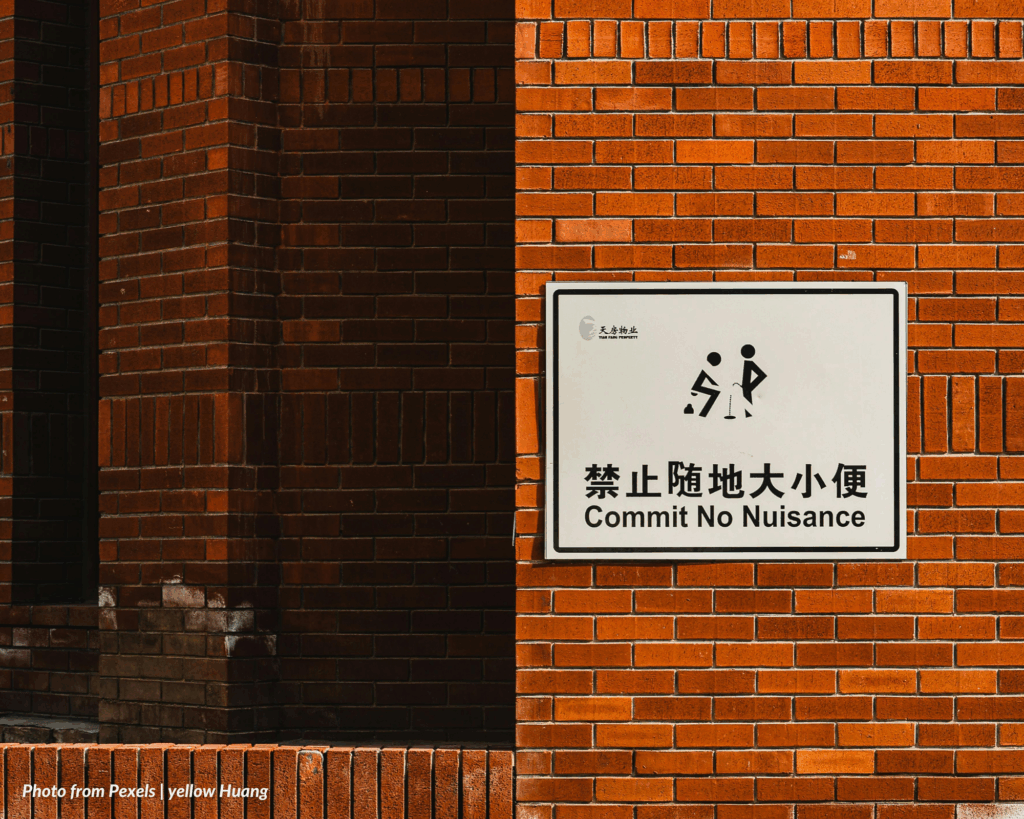
Photo from Pexels | yellow Huang
The following post does not create a lawyer-client relationship between Alburo Alburo and Associates Law Offices (or any of its lawyers) and the reader. It is still best for you to engage the services of a lawyer or you may directly contact and consult Alburo Alburo and Associates Law Offices to address your specific legal concerns, if there is any.
Also, the matters contained in the following were written in accordance with the law, rules, and jurisprudence prevailing at the time of writing and posting, and do not include any future developments on the subject matter under discussion.
AT A GLANCE:
According to Article 694 of the Civil Code, a nuisance is any act, omission, establishment, business, condition of property, or anything else which:
(1) Injures or endangers the health or safety of others; or
(2) Annoys or offends the senses; or
(3) Shocks, defies or disregards decency or morality; or
(4) Obstructs or interferes with the free passage of any public highway or street, or any body of water; or
(5) Hinders or impairs the use of property.
Nuisance may be categorized into:
- Public (or common) nuisance;
- Private nuisance;
- Nuisance per se;
- Nuisance per accidens.
According to the case of Rana vs. Uy, G.R. No. 192861 and 192862, June 30, 2014, the term “nuisance” is deemed to be “so comprehensive that it has been applied to almost all ways which have interfered with the rights of the citizens, either in person, property, the enjoyment of his property, or his comfort.”
Article 695 of the Civil Code classifies nuisances with respect to the object or objects that they affect. In this regard, a nuisance may either be:
(a) a public nuisance; or
(b) a private nuisance.
Jurisprudence further classifies nuisances in relation to their legal susceptibility to summary abatement (that is, corrective action without prior judicial permission). In this regard, a nuisance may either be:
(a) a nuisance per se; or
(b) a nuisance per accidens.
Public or common nuisance
A public nuisance is one which “affects a community or neighborhood or any considerable number of persons, although the extent of the annoyance, danger or damage upon individuals may be unequal”.
Private nuisance
A private nuisance is one “that is not included in the foregoing definition” or, as case law puts it, one which “violates only private rights and produces damages to but one or a few persons”.
Nuisance per se
A nuisance per se is one which “affects the immediate safety of persons and property and may be summarily abated under the undefined law of necessity”.
Nuisance per accidens
A nuisance per accidens is that which “depends upon certain conditions and circumstances, and its existence being a question of fact, it cannot be abated without due hearing thereon in a tribunal authorized to decide whether such a thing does in law constitute a nuisance.”
Click here to subscribe to our newsletter
Alburo Alburo and Associates Law Offices specializes in business law and labor law consulting. For inquiries regarding legal services, you may reach us at info@alburolaw.com, or dial us at (02)7745-4391/ 09175772207/ 09778050020.
All rights reserved.
Leave a Reply