

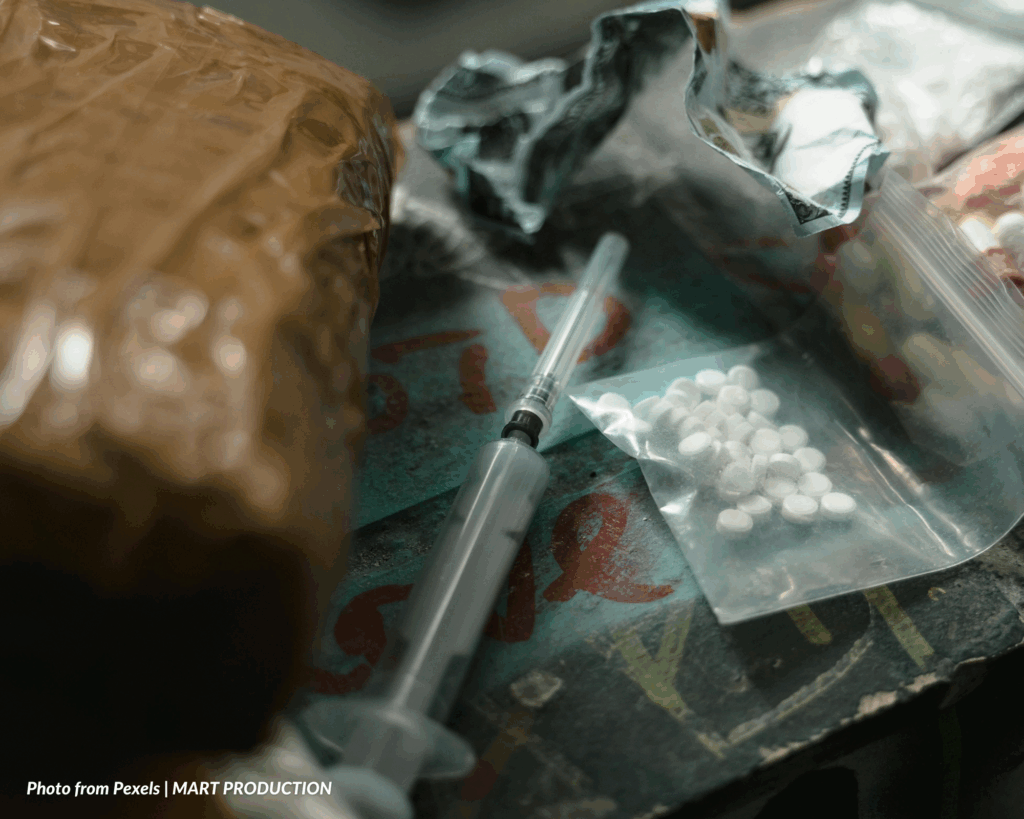
Photo from Pexels | MART PRODUCTION
The following post does not create a lawyer-client relationship between Alburo Alburo and Associates Law Offices (or any of its lawyers) and the reader. It is still best for you to engage the services of a lawyer or you may directly contact and consult Alburo Alburo and Associates Law Offices to address your specific legal concerns, if there is any.
Also, the matters contained in the following were written in accordance with the law, rules, and jurisprudence prevailing at the time of writing and posting, and do not include any future developments on the subject matter under discussion.
AT A GLANCE:
In the case of People of the Philippines v. Rosario, G.R. No. 235658, June 22, 2020, the Supreme Court held that to sustain a conviction for the offense of illegal sale or possession of dangerous drugs under R.A. No. 9155, it is of utmost importance to establish with moral certainty the identity of the confiscated drug. To remove any doubt or uncertainty on the identity and integrity of the seized drug, it must be shown that the substance illegally possessed or sold by the accused is the same substance offered and identified in court. This requirement is known as the Chain of Custody Rule under Republic Act No. 9165.
Chain of custody is the duly recorded, authorized movements, and custody of the seized drugs at each stage, from the moment of confiscation to the receipt in the forensic laboratory for examination until it is presented to the court. Section 21 of R.A. No. 9165 requires the apprehending team, after seizure and confiscation, to immediately conduct a physical inventory of, and photograph, the seized drugs in the presence of:
- The accused or the persons from whom such items were confiscated and/or seized, or his/her representative or counsel;
- Elected public official; and
- A representative of the National Prosecution Service or the media.
These witnesses should be present at the time of the apprehension of the accused and must sign all the copies of the inventory and obtain a copy thereof.
As a method of authenticating evidence, the chain of custody rule requires that the admission of an exhibit be preceded by evidence sufficient to support a finding that the matter in question is what the proponent claims it to be. It would include testimony about every link in the chain, from the moment the item was picked up to the time it is offered into evidence, in such a way that every person who touched the exhibit would describe how and from whom it was received, where it was and what happened to it while in the witnesses’ possession, the condition in which it was received and the condition in which it was delivered to the next link in the chain. These witnesses would then describe the precautions taken to ensure that there had been no change in the condition of the item and no opportunity for someone not in the chain to have possession of the same.
The procedure enshrined in Section 21 of R.A. No, 9165 is a matter of substantive law, and cannot be brushed aside as a simple procedural technicality; or worse, ignored as an impediment to the conviction of illegal drug suspects. The police officers of PDEA agents must strictly comply with the procedure laid out, although failure to strictly do so does not, ipso facto, render the seizure and custody over the illegal drugs as void and valid if:
- There is justifiable ground for such noncompliance; and
- The integrity and evidentiary value of the seized evidence were preserved.
In People v. Lim, G.R. No. 231989, September 4, 2018, the Supreme Court held that the prosecution bears the burden of proving a valid cause for non-compliance with the procedure laid down in Section 21 of R.A. No. 9165, as amended. It has the positive duty to demonstrate observance thereto in a such a way that during the trial proceedings, it must initiate in acknowledging and justifying any perceived deviations from the requirements of law. Its failure to follow the mandated procedure must be adequately explained, and must be proven as a fact in accordance with the rules on evidence. It should take note that the rules require that the apprehending officers do not simply mention a justifiable ground, but also clearly state this ground in their sworn affidavit, coupled with a statement on the steps they took to preserve the integrity of the seized items. Strict adherence to Section 21 is required where the quantity of illegal drugs seized is miniscule, since it is highly susceptible to planting, tampering or alteration of evidence.
It must be alleged and proved that the presence of the three witnesses to the physical inventory and photograph of the illegal drug seized was not obtained due to reason/s such as:
- Their attendance was impossible because the place of arrest was a remote area;
- Their safety during the inventory and photograph of the seized drugs was threatened by an immediate retaliatory action of the accused or any person/s acting for and in his/her behalf;
- Earnest efforts to secure the presence of DOJ or media representative and an elected public official within the period required under Article 125 of the Revised Penal Code prove futile through no fault of the arresting officers, who face the threat of being charged with arbitrary detention; or
- Time constraints and urgency of the anti-drug operations, which often rely on tips of confidential assets, prevented the law enforcers from obtaining the presence of the required witnesses even before the offenders could escape.
Failure of the prosecution to establish beyond reasonable doubt the unbroken chain of custody of the drugs seized from appellant, and to prove as a fact any justifiable reason for non-compliance with Section 21 and its IRR, accused must be acquitted.
Related Articles:
- Does the President have the power to impose maximum retail prices over drugs and medicines?
- Dangerous Drugs Board
Click here to subscribe to our newsletter
Alburo Alburo and Associates Law Offices specializes in business law and labor law consulting. For inquiries regarding legal services, you may reach us at info@alburolaw.com, or dial us at (02)7745-4391/ 0917-5772207/ 09778050020.
All rights reserved.