

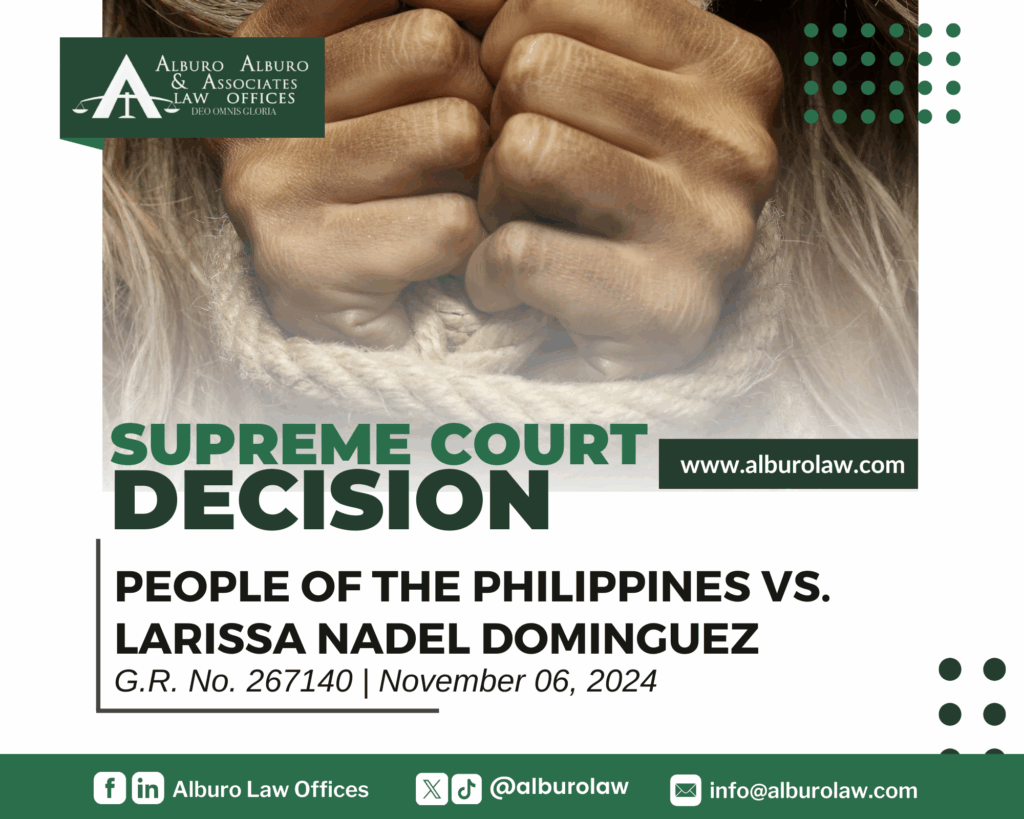
Photo from Unsplash | engin akyurt
The following post does not create a lawyer-client relationship between Alburo Alburo and Associates Law Offices (or any of its lawyers) and the reader. It is still best for you to engage the services of a lawyer or you may directly contact and consult Alburo Alburo and Associates Law Offices to address your specific legal concerns, if there is any.
Also, the matters contained in the following were written in accordance with the law, rules, and jurisprudence prevailing at the time of writing and posting, and do not include any future developments on the subject matter under discussion.
AT A GLANCE:
Sexual intercourse is not necessary to establish that the recruitment was for the purpose of sexual exploitation and prostitution under the Anti-Trafficking Act.
When AAA was 15 years old, Dominguez offered her work as a babysitter for her 1-year-old child in Cagayan. Instead of working as a babysitter, AAA was made to work against her will as an entertainer with the name “AAA”. She worked as an entertainer for more than a week, where she would sit beside male customers, drink beer, and let the men caress her, kiss her, and touch her private parts. Some customers asked her to have sex with them, but she refused.
Therefore, based on the foregoing, is Dominguez guilty of Qualified Trafficking in Persons?
The Supreme Court’s Decision
The Supreme Court held that Dominguez was guilty of Qualified Trafficking Persons because all the elements of are present, to wit:
(1) The act of “recruitment, transportation, transfer or harbouring, or receipt of persons with or without the victim’s consent or knowledge, within or across national borders[;]”
(2) The means used which include “threat or use of force, or other forms of coercion, abduction, fraud, deception, abuse of power or of position, taking advantage of the vulnerability of the person, or, the giving or receiving of payments or benefits to achieve the consent of a person having control over another; and
(3) The purpose of trafficking is exploitation which includes “exploitation or the prostitution of others or other forms of sexual exploitation, forced labor or services, slavery, servitude or the removal or sale of organs.
It is undisputed that AAA was a minor at the time she was recruited by Dominguez. In her testimony, she clearly narrated that Dominguez recruited her, taking advantage of her minority and financial need, under the guise of being hired as a domestic helper (“babysitter”), but for the real purpose of sexual exploitation or prostitution.
AAA was subjected to sexual exploitation and prostitution. Sexual intercourse is not necessary to establish that the recruitment was for the purpose of sexual exploitation and prostitution under the Anti-Trafficking Act. As defined under the amendment in Republic Act No. 10346, sexual exploitation and prostitution may occur even through lascivious conduct. It is sufficient that the accused has lured, enticed , or engaged its victims or transported them for the established purpose of exploitation, which includes prostitution, sexual exploitation, forced labor, slavery, and the removal or sale of organs.
Hence, even if AAA refused to engage in sexual intercourse with the male customers, it was clearly part of the work she was recruited for. Indeed, what is essential under the Anti-Trafficking Act is that a person is recruited and transported for the purpose of sexual exploitation and prostitution for money or profit.
Section 10 (e) of the Anti-Trafficking Act provides that “any person found guilty of qualified trafficking under Section 6 shall suffer the penalty of life imprisonment and a fine of not less than PHP 2 million but not more than PHP 5 million.” Thus, the lower courts correctly sentenced Dominguez to suffer the penalty of life imprisonment and to pay a fine of PHP 2 million.
Source:
People of the Philippines vs. Larissa Nadel Dominguez
G.R. No. 267140 | November 06, 2024
RELATED ARTICLES:
Click here to subscribe to our newsletter
Alburo Alburo and Associates Law Offices specializes in business law and labor law consulting. For inquiries regarding legal services, you may reach us at info@alburolaw.com, or dial us at (02)7745-4391/ 0917-5772207/ 09778050020.
All rights reserved.